How to Outsource SEO Without Losing Your Rankings
How to Outsource SEO Without Losing Your Rankings Rankings don’t...
Read More →
Most “versus” articles frame two rival camps. The more useful question is narrower: which parts of your SEO work carry over unchanged, and which parts need something new?

Traditional SEO optimizes a site for visibility and performance across conventional search experiences, while AI SEO extends that work to generated-answer experiences, where additional goals include being accurately represented, cited, linked, or mentioned. They aren’t rival disciplines: Google says its generative AI features on Search are rooted in its core Search ranking and quality systems, so the foundation is shared. The AI-specific additions are practical ones around generated-answer visibility, query fan-out, content clarity, third-party representation, platform-specific access, and measurement, and both still need to support business outcomes.
Methodology:This guide draws on Google Search Central’s guide to optimizing for generative AI features (last updated July 2026), Google’s Search Console Help pages for the Performance report and the Generative AI performance report, Google Analytics Help’s default channel group definitions, OpenAI’s documentation on its web crawlers, and Pew Research Center’s July 2025 browsing study, alongside recurring patterns Growzify observes in client work. Pew’s data reflects U.S. browsing in March 2025, so treat it as directional.
The useful way to read this table is as a shared foundation plus added AI-search considerations, not as two separate systems.
| Dimension | Core SEO / classic-search emphasis | Additional AI-search consideration |
| Visibility | Search-result visibility, traffic, and business outcomes | Citations, supporting links, and brand representation, in addition to traffic |
| Output | Conventional search results and SERP features, usually organized around individual results | A synthesized answer that can include supporting sources and links |
| Query handling | Search ranking and query understanding | Generative features may additionally use query fan-out |
| Eligibility | Search technical and indexing eligibility | Google also requires snippet eligibility and inclusion in generative AI features in Search Console |
| Content | Helpful, unique, people-first | Google’s AI guidance explicitly emphasizes non-commodity content |
| Authority | Google’s ranking and quality systems, including link analysis among many signals | Growzify treats credible third-party representation as a practical brand-visibility consideration |
| Access | Search-engine crawlers such as Googlebot and Bingbot | Platform-specific crawlers and controls may also matter |
| Measurement | Clicks, impressions, CTR, position, conversions | Generative impressions, AI referrals, prompt sampling, mentions and citations |
The rest of this guide explains each row and then helps you decide where to invest first.
Start with the overlap, because it’s larger than most comparisons admit.Google’s guide to optimizing for generative AI featuresanswers the “is SEO still relevant” question directly: yes, because its generative AI features are rooted in its core Search ranking and quality systems.
It goes further. From Google Search’s perspective, optimizing for generative AI search is optimizing for the search experience, and so it is still SEO. That includes the work people label AEO and GEO.
The guide describes two techniques behind those features:
Its foundational advice will sound familiar:
In Growzify’s reading, a page that fails these basics is unlikely to benefit from any AI-specific work. The shared foundation comes first.
The practical difference isn’t “old SEO versus new SEO.” It’s a shared SEO foundation with additional AI-search considerations.
Core SEO still manages crawlability, indexing, site architecture, helpful content, Search visibility, links, page experience, and business outcomes.
AI-search work additionally looks at visibility inside generated answers, query fan-out implications, platform-specific crawler access, how accurately the brand is represented, and measurements that conventional rankings can’t fully capture.
For most businesses, the goal should be one SEO program with additional AI-search controls and measurement, not two disconnected optimization programs.
AI search changes what visibility can look like. A user may discover your brand, content, or expertise inside an AI-generated answer before visiting your website, so success is no longer measured by clicks alone.
Conventional search results and SERP features are usually organized around individual results. You can see a position, a click-through rate, and a visit.
AI answers change the shape of the page.Pew Research Center’s July 2025 studyfollowed the browsing of 900 U.S. adults in March 2025. Users clicked a traditional result link in 8% of visits when an AI summary appeared, versus 15% when none did. They clicked a link inside the summary in 1% of visits to pages with one.
The same study found that 12,593 of 68,879 tracked Google searches produced an AI summary, or roughly 18%. In other words, most searches in that sample did not contain an AI summary. Pew describes the summary as appearing alongside the standard search results, so conventional results were still present when one appeared.
That’s one study, one country, and one month, so read it as a signal. It does suggest two things at once. Most searches in the sample didn’t include an AI summary, and when one did appear, fewer visits turned into clicks on traditional results.
So success broadens; it doesn’t switch. You still want clicks and conversions. You also want to be a visible, accurately described source when the answer is generated.
Conventional Search responds to the user’s submitted query using Google’s ranking and query-understanding systems. Google’s generative AI features can go further through query fan-out, where the model issues multiple related searches to gather information for different parts of the original question.
Google’s guide describes query fan-out as a set of concurrent, related queries generated by the model to request more information. For you, that means a single user question can pull in sources for several related sub-questions.
Growzify’s practical reading is that coverage matters alongside depth on a single page. Check whether the obvious follow-up questions a buyer would ask are answered somewhere on your site.
This is an interpretation. Google presents fan-out as how the feature works, not as something to engineer around, so it isn’t a reason to create a page for every related query.
The content standard is largely shared. Google asks for unique, helpful, people-first content in both cases, and its AI guidance explicitly warns against commodity content.
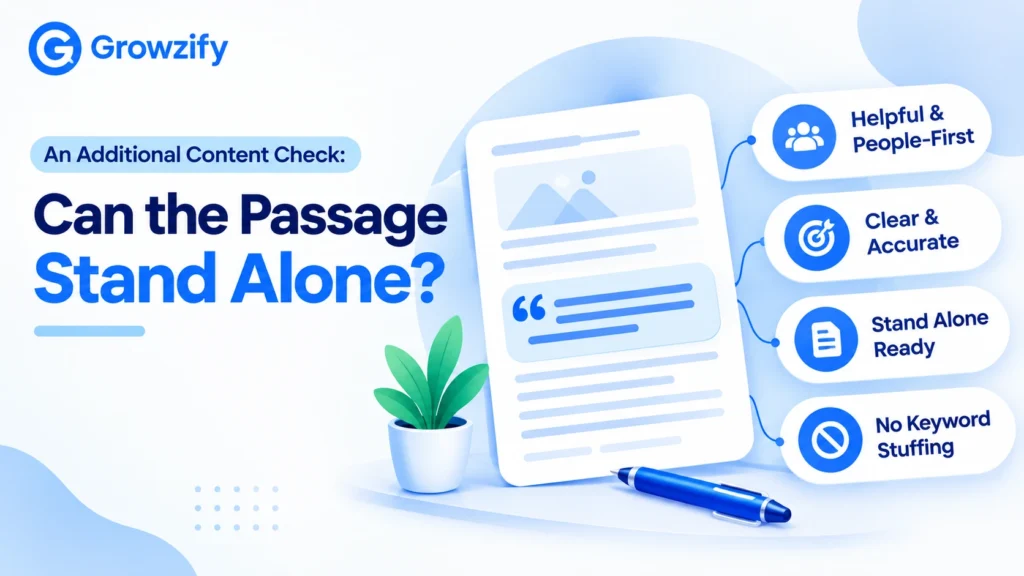
On top of that, Growzify suggests one practical check: “Could this section be quoted on its own and still be accurate?” That’s a clarity check, not a Google requirement. Google’s guide says you don’t need to write in a specific way just for generative AI search, and there’s no requirement to break content into tiny pieces.
So the shift is small. Write for people, state things plainly, and avoid padding that only works if the reader sees the whole page.
Google uses link-analysis systems as part of its broader set of ranking systems, and practitioners also consider wider evidence of reputation and authority. From Growzify’s practitioner perspective, AI-search visibility adds another useful question: what do credible third-party sources say about your business?
Be careful here. Google’s guide advises against seeking inauthentic “mentions” across the web, noting that it isn’t as helpful as it might seem. Genuine editorial coverage, expert contributions, and useful data are different from manufactured volume.
Google doesn’t document a separate “mention score” for AI answers. Earn useful third-party coverage because it improves brand presence, corroboration, PR, and discoverability, not because it is a confirmed AI-citation factor.
In Growzify’s view, the practical task is the same as good PR. Be worth mentioning, and make it easy for relevant publications to find the evidence.
For many businesses, traditional technical SEO focuses primarily on access for conventional search crawlers such as Googlebot and Bingbot. AI-search visibility can add platform-specific access decisions. Two are worth checking.
First, Google’s guide says a site must be included in Search generative AI features in Search Console to be eligible for display in those features. That’s worth confirming on its own.
Second, other AI platforms use their own agents.OpenAI’s crawler documentationdescribes OAI-SearchBot for surfacing sites in ChatGPT search and GPTBot for content that may be used in training. It says each can be managed independently in robots.txt. It also says ChatGPT-User handles user-initiated actions, where robots.txt rules may not apply.
Search visibility and model-training access can be separate policy decisions. So a crawler policy becomes a decision, not a default.
This is where the added AI-search work differs most, so it gets its own table. Each source answers a different question.
| Question | Best current source |
| How did conventional Google visibility and clicks perform? | Search ConsolePerformance report:clicks, impressions, CTR, position, queries |
| Were we shown in Google’s AI Overviews or AI Mode? | Search ConsoleGenerative AI performance report:impressions by page, country, device, and date |
| Did recognizable AI-assistant referral visits reach the site? | GA4AI Assistant default channel |
| What do selected assistants say about us? | Repeatable prompt sampling |
| Did AI influence the buying path? | Analytics, CRM, and buyer-reported evidence |
The Performance report shows clicks, impressions, CTR, and average position, and it can be grouped by queries, pages, countries, devices, search appearance, and dates. Its search types include web text-based and web multimodal.
Google’s Generative AI performance report is narrower. It shows impressions only, with no clicks, click-through rate, or query data. Google says it was rolled out to all websites worldwide as of August 31, 2026.
Google also says the report includes data from the Web search type in the Performance report. Treat it as an AI-specific impressions view inside broader Web Search reporting, and don’t add the two numbers together as though they were separate traffic.
The GA4 AI Assistant channel covers visits from sources like ChatGPT, Gemini, DeepSeek, Copilot, and Grok. Google states it excludes Google’s AI Overviews and AI Mode. Some assistants may land in other channels, and visits with no referrer can fall into Direct, so treat the numbers as a minimum.
These sources aren’t interchangeable:
An AI impression, a citation, a mention, a referral visit, and a conversion are different events. Don’t combine them into one “AI visibility” number, and treat prompt sampling and buyer feedback as directional, not exact.
Here’s an illustration for a fictional company, Northline Payroll, with a page called “Payroll software for restaurants.” It isn’t a real client case.
| Area | What a traditional audit finds | What an AI-visibility audit adds |
| Ranking | The page sits on page one for its target query | Brand is absent from sampled assistant answers for the same topic |
| Content | Section on tip reporting is thin | Page never says who it’s for, or who it isn’t for |
| Authority | Few referring domains | No independent roundup or comparison mentions the brand |
| Technical | Page is indexed and fast | A CDN rule accidentally blocks OAI-SearchBot, the crawler for ChatGPT search |
| Measurement | Clicks are flat | Generative AI report shows no impressions for the page |
The findings overlap but aren’t identical. Fixing the thin section helps both audits.
These observations identify possible gaps, not proven causes. A missing third-party mention or a missing generative-AI impression should trigger diagnosis before the team assumes a specific fix will cause inclusion.
Fixing an accidental OAI-SearchBot block addresses ChatGPT search access. It doesn’t establish visibility across other AI systems or affect Google’s eligibility.
Third-party representation becomes an additional question in the AI-visibility audit, although genuine editorial coverage can also support conventional discovery, referral traffic, and broader brand authority.
Notice what the example doesn’t need: special markup, a new file, or a rewrite into fragments. Most of the value comes from clearer positioning, fixed access, and real evidence.
If your traditional SEO is already solid, the added workload may be smaller than the hype suggests. In Growzify’s experience, AI SEO often adds governance and measurement layers rather than requiring a separate content universe. It usually comes down to a handful of recurring tasks:
Each of these builds on work you’d do anyway. None requires a separate content library, and most can sit inside your existing editorial and reporting calendar.
The effort rises where you have little to build on. A site with thin content, weak positioning, or poor technical health needs the shared foundation first, and AI-specific tasks will add little until that’s fixed.
A note on terminology: you’ll see GEO and AEO used for parts of this work, and usage varies. This guide uses AI SEO as the umbrella and compares it with traditional SEO, so the same distinctions apply whichever label you prefer.
The right priority depends on your current SEO performance, business model, and how your customers search. AI SEO services should support your existing strategy rather than automatically becoming a separate program.
If your site has crawling, indexing, technical, or content problems, address those before investing heavily in AI visibility. Google’s generative features still depend on strong search fundamentals.
If rankings are stable but clicks are flat, review SERP changes, query mix, AI visibility, competition, and positioning before deciding what needs to change.
If customers actively use AI tools during research and buying decisions, stronger AI visibility may deserve more attention. If a platform has little relevance to your audience, deprioritize it.
Local businesses should keep Google Business Profile information accurate, while ecommerce businesses should maintain reliable Merchant Center data. Larger organizations should integrate AI-search work into existing SEO, content, and governance processes.
If information about your business is inconsistent or limited across the web, review how credible third-party sources describe your brand. Growzify treats this as a practical visibility consideration, not a confirmed universal AI-citation factor.
AI-specific optimization still has value, but the priority should remain on strong fundamentals, clear information, credible evidence, accurate brand representation, and useful measurement.
Avoid two separate programs with two backlogs. A single workflow keeps effort and reporting aligned.
Growzify’s roundup ofAI SEO tools for content teamscovers tool options for the sampling and tracking steps. For page-level structure, see the guide onmatching search intent to rank in Google AI Overviews.
For most businesses, AI SEO should be an additional visibility and measurement layer inside the existing SEO program, not a second disconnected discipline.
What is the difference between AI SEO and traditional SEO?
Traditional SEO optimizes a site for visibility and performance across conventional search experiences. AI SEO extends that work to generated-answer experiences, where additional goals include being accurately represented, cited, linked, or mentioned. They share a foundation, since Google says its generative AI features are rooted in its core Search ranking and quality systems.
Is AI SEO separate from traditional SEO?
Not completely. For Google, generative AI features use the same core Search ranking and quality systems, so traditional SEO remains the foundation.
AI SEO mainly adds generated-answer visibility goals, platform-specific crawler decisions, extra brand-representation checks, and new measurement methods such as generative-AI impressions, assistant referrals, and prompt sampling.
Is traditional SEO dead?
No. Google says SEO best practices continue to be relevant for its generative AI features. In Pew’s study, roughly 18% of tracked Google searches included an AI summary, meaning most did not. Standard results were also still present when AI summaries appeared.
Do I need both AI SEO and traditional SEO?
Most businesses need one strong SEO program that also accounts for relevant AI-search surfaces. The amount of additional AI-specific work depends on platform relevance, current eligibility, buyer behavior, and how strong the existing SEO foundation already is.
Does ranking first guarantee an AI citation?
No. Google describes using core Search ranking systems to retrieve pages and query fan-out to gather more results, but nothing in its guide promises that a top ranking leads to inclusion in an AI answer.
How do I measure AI SEO compared with traditional SEO?
Use Search Console’s Performance report for clicks, impressions, CTR, and position, and the Generative AI performance report for impressions in AI Overviews and AI Mode. Add the GA4 AI Assistant channel for recognized assistant referrals, which excludes AI Overviews and AI Mode, plus monthly prompt sampling and buyer feedback. Treat the last two as directional.
Are an AI impression, a citation, and a mention the same thing?
No. An AI impression, a citation, a brand mention, a referral visit, and a conversion are different events. Measure them separately rather than combining them into one score.
Do I need special markup for AI search?
Not for Google. Its guide says you don’t need new machine-readable files, AI text files, or special schema.org markup to appear in Google Search.
Which should a small business do first?
Start with eligibility and the basics: indexed pages, clear positioning, and accurate Business Profile or product data where relevant. Then add measurement. Both rely on those same foundations.
If you’d like help auditing where your business stands on both, Growzify’sAI SEO servicesteam can walk through what to fix first.

At Growzify, we are dedicated to helping your business achieve its goals. Are you Ready to take the next step?
Call Now





Growzify digital team is very effective, and easy to work with. Very strong communication and always up for suggestions. Saw 300% growth in web traffic 170% growth in revenue through Facebook ad’s & Amazon. I recommended them to my fellows and they turned their online business into a money making machine.