How to Manage SEO Outsourcing Across Multiple Teams
How to Manage SEO Outsourcing Across Multiple Teams A single-owner...
Read More →

What makes in-house enterprise SEO work different day-to-day is that the role expands beyond identifying SEO opportunities into managing the coordination, prioritization, ownership, and release processes required to get those opportunities implemented and validated: getting technical fixes into an engineering release cycle you don’t control, aligning priorities across product, content, legal, and regional teams that don’t report to you, and maintaining ongoing monitoring alongside periodic projects.
Methodology:This guide is grounded in Google Search Central’s own documentation on when and how to work with SEO expertise, alongside Lumar’s published enterprise SEO survey research and recurring patterns observed in Growzify enterprise SEO reviews. Statements attributed to Growzify are practitioner observations, not confirmed Google ranking mechanisms, and the composite example later in this article is illustrative rather than a client case study.
On a small site, an SEO’s decision and an SEO’s action are often the same step. Identify the fix, make the fix, done.
At enterprise scale, those two things separate almost completely. An in-house SEO can diagnose a problem accurately and still have no direct ability to fix it, since the fix lives in a shared template, a CMS a different team owns, or a codebase behind an engineering release process with its own competing priorities. The actual day-to-day job becomes getting that diagnosis turned into someone else’s action item, sequenced correctly, and verified after it ships.
Google’s own guidance on hiring SEO expertiserecommends involving SEO early when planning a redesign or new site, so search considerations can be incorporated from the beginning rather than retrofitted later. At enterprise scale, that recommendation translates into something more demanding day-to-day: close, ongoing coordination with the teams actually designing, developing, and operating the site, not a single early conversation.
This isn’t just a feeling in-house SEOs have.Lumar surveyed 204 marketing, engineering, and other digital leadersat organizations running sites with more than 10,000 URLs, and found that 60 percent selected executing SEO improvements and monitoring at scale as a top challenge, and 53 percent selected managing SEO responsibilities across multiple departments, both ranking above general fixes to existing SEO problems at 34 percent.
That ranking supports the idea that operational execution and cross-department coordination are major challenges at enterprise scale, without implying that technical diagnosis has stopped being difficult; the survey measured which challenges respondents selected, not whether the underlying SEO knowledge was already in place. The respondents were digital leaders at large-scale organizations generally, not specifically in-house SEO practitioners, but the pattern lines up with what the coordination-heavy day-to-day role described above would predict.
Enterprise SEO work runs on three distinct cadences at once, and conflating them is a common source of confusion about what the day-to-day job actually involves.
| Rhythm | Purpose | Typical trigger |
| Audit | Broad, periodic review of the whole site’s systems | Scheduled interval or a major event |
| Release control | Catch SEO-affecting regressions before a specific deployment ships | Every release that could plausibly affect crawling, indexing, or rendering |
| Monitoring | Detect production changes after code is already live | Continuous, at a cadence matched to release pace |
An in-house enterprise SEO usually participates in all three simultaneously, which is a meaningfully different workload than running one comprehensive review on a fixed schedule and calling the job done between cycles.
On a small team, coordination might mean a quick message to one developer. At enterprise scale, out of whole technical SEO checklist a single technical SEO fix can require sign-off or cooperation from engineering, the CMS platform team, legal or compliance for certain content types, regional teams for market-specific pages, and sometimes a separate analytics or data team to confirm the fix worked.
This is why an enterprise in-house SEO’s calendar looks different from a smaller-site SEO’s. In Growzify’s experience with enterprise organizations, a real share of the week goes toward explaining priority, translating a technical issue into terms a non-SEO stakeholder can act on, and following up on work that’s sitting in someone else’s queue rather than a shared one. The SEO expertise is necessary, but organizational navigation can end up mattering just as much for getting a fix actually shipped. With so many moving parts, having atechnical SEO monitoring stack for large websitescan help teams track changes, validate fixes, and catch new issues as they appear.
In-houseenterprise SEO basicsstill includes defined projects, migrations, redesigns, international launches, structured-data rollouts, the same kind of engagements an outside consultant or agency might run. What’s different is that those projects don’t happen in isolation from an ongoing monitoring responsibility, since releases ship and content updates continuously in between them, and any one can introduce a regression across thousands of pages at once.
Keep core property ownership business-controlled.A Search Console property needs at least one verified owner, or nobody retains access at all, and Google’s own documentation notes that as long as a removed owner’s verification token remains in place, that person can re-verify ownership even after being removed as a user.
Keep at least one verified owner under a business-controlled account rather than making an outside provider the sole verified owner, and if a previous provider ever had owner-level access, check both the current user list and any leftover verification tokens during handoff, not just the visible user list.
CMS access, scoped to what the work needs. A provider preparing content may need no CMS access at all if drafts are handed to an internal team for publishing. If the provider is responsible for uploading or publishing directly, grant the appropriate editor or publishing role rather than full administrative access unless administration is genuinely required.
Anything else the work touches.Depending on scope, this might include Google Business Profile, DNS or hosting if technical changes are involved, or a tag management platform. List these upfront rather than discovering the gap mid-engagement.
For every system granted, it’s worth tracking who has access, what permission level, who approved it, when it was granted, when it should be reviewed, and how it gets revoked, whether or not a business uses formal access-management software to do it. A simple rule worth applying across all of it: grant the least access a task genuinely requires, and revisit permissions if the scope changes later.
That adds a parallel rhythm alongside project work: not replacing “complete a project” with “watch a system,” but running both at the same time. Monitoring’s job is to trigger investigation, not to automatically classify every movement it flags as a defect; a dashboard that treats every fluctuation as confirmed damage trains people to stop trusting it.
Growzify’s guide on theenterprise technical SEO checklistcovers the periodic, comprehensive side of that work; the in-house reality also includes an ongoing monitoring layer, at whatever cadence the site’s release pace actually warrants, that no single scheduled audit captures on its own.
This is a practitioner framework Growzify uses to describe what actually differs about the day-to-day job at enterprise scale, not a Google-documented process. It has four layers, and each one is a genuinely different skill from classicenterprise SEO strategyswork.
| Layer | What it actually looks like day-to-day | Why it’s different from a small site or agency project |
| Release-cycle dependency | Getting fixes into someone else’s engineering sprint, not implementing them directly | In many organizations, the SEO doesn’t have direct write access to the systems that need to change |
| Cross-functional coordination | Translating technical findings for legal, regional, product, and content stakeholders | A fix often needs buy-in from people whose priorities aren’t SEO |
| Ongoing monitoring | Watching for regressions at a cadence matched to release pace, alongside periodic audits, not only at fixed audit intervals | Releases and content changes can happen faster than a fixed audit schedule alone would catch |
| Institutional navigation | Knowing which team owns which template, system, or decision | This knowledge takes real time to build and rarely transfers cleanly to an outside consultant |
An outside consultant can often match or exceed an in-house SEO’s technical knowledge. What’s much harder to replicate quickly is the fourth layer, knowing precisely who owns what, which is built through months or years inside the organization, not through expertise alone.
Institutional knowledge is a real in-house advantage; undocumented institutional knowledge is an enterprise risk, since a program that depends entirely on one person remembering who owns the PDP template has a single point of failure built into its process.
The distinction worth making explicit: many of the constraints above, release-cycle dependency, cross-functional coordination, ongoing monitoring, aren’t unique to in-house roles. An agency or consultant working with a large organization can run into the same walls. What’s genuinely different about the in-house role is persistence.
| Area | In-house | Agency or consultant |
| Organizational context | Deep, built up continuously | Has to be learned fresh for each client |
| Implementation authority | Varies, often indirect | Usually advisory, or shared with the client’s own teams |
| Stakeholder relationships | Long-term, carried across projects | Tied to the length of the engagement |
| Roadmap ownership | Often continuous, across release cycles | Depends on the scope of the contract |
| Monitoring responsibility | An ongoing internal responsibility | Depends on what the engagement includes |
| Institutional knowledge | Accumulates over time inside the organization | Harder to build to the same depth |
| Outside perspective | Can become internally constrained by familiarity | Often broader, informed by other clients |
Large organizations often work best with persistent internal ownership plus selective external specialization, rather than treating in-house and agency as a strict either-or choice. The in-house team retains business context, stakeholder relationships, roadmap continuity, and ongoing accountability.When managingenterprise SEO for large websites, external specialists can add deep technical expertise, independent validation, migration support, automation, or temporary capacity.Neither model removes the need for an internal owner who can connect SEO requirements to the organization’s actual product and engineering processes.
Coordination alone isn’t the mature end state; a good enterprise SEO function tries to reduce how much of its output depends on repeated manual persuasion by building the coordination into a repeatable system instead. This is a practitioner framework, not a Google-documented process.
| Layer | What happens |
| 1. Detect | Surface an issue or opportunity through monitoring, audit, or research |
| 2. Scope | Identify the affected templates, URL cohorts, and systems |
| 3. Quantify | Estimate severity, blast radius, and business importance |
| 4. Assign | Identify the team or person actually accountable for the fix |
| 5. Specify | Write the expected behavior and acceptance criteria, not just the recommendation |
| 6. Prioritize | Place the work against the engineering and business roadmap |
| 7. Ship | Move the change through the release process |
| 8. Validate | Confirm the intended production state actually shipped |
| 9. Monitor and learn | Watch for downstream effects and update documentation, tests, and ownership records |
Institutional knowledge stops being fragile once it’s written down. A simple ownership map, kept current rather than assembled once and forgotten, turns “who owns this” from a question someone has to ask around into something anyone on the team can look up.
| SEO system | Typical owner | Usual SEO partner | Release mechanism |
| Redirect Chains & Canonical tags | Platform engineering | Technical SEO | Template release |
| Navigation | Product | SEO | Product sprint |
| Sitemap generation | Platform engineering | Technical SEO | Automated |
| Product copy | Merchandising | Content SEO | CMS |
| Hreflang Tags | International platform team | International SEO | Template release |
| Structured data | Engineering | Technical SEO | Component release |
This is one of the more distinctive day-to-day skills in enterprise in-house SEO, and it’s rarely taught as an SEO skill at all. A correct technical finding accomplishes little if it never gets prioritized against everything else competing for the same engineering time.
This part of the role increasingly resembles internal product-management work layered on top of SEO expertise: defining the problem, scoping the affected system, documenting expected behavior, communicating business risk, and moving the change through a shared engineering roadmap, rather than relying on relationship credibility alone to get a request taken seriously.
Google’s own guidance about SEO working best in collaboration with the people who build the site reflects the same principle from the opposite direction; the SEO’s job is to make that collaboration function repeatedly, not just to identify what needs fixing once.
Relationships still help, but a mature organization shouldn’t depend on them as the primary execution mechanism. A documented responsibility model, RACI, DACI, or whatever equivalent the organization already uses, for who recommends, decides, implements, and validates SEO-impacting changes reduces how much a fix’s fate rides on one person’s persuasiveness.
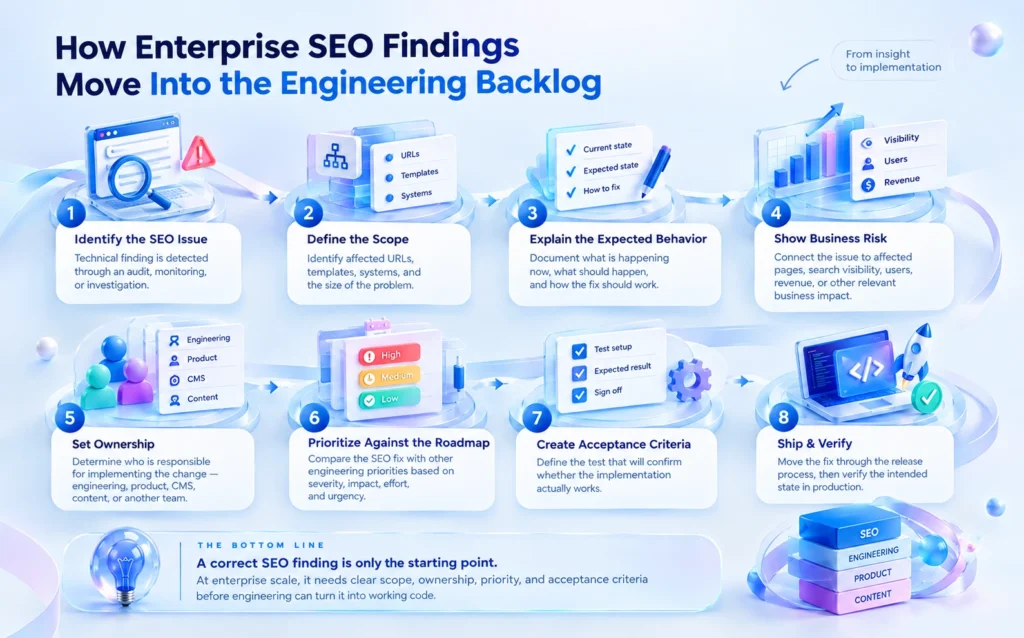
“Fix the canonical tags” is a finding, not an engineering specification. An implementation-ready enterprise SEO ticket should identify the affected URL or template cohort, current behavior, expected behavior, relevant examples, severity, dependencies, owner, and the test that determines whether the change passed. The goal is to make the expected SEO state observable enough that engineering and QA can validate it without having to reinterpret the original recommendation.
A worked example of what that looks like in practice:
Issue:PDP canonical tags are generated from the wrong regional host.
Affected cohort:Approximately 48,000 UK product detail page URLs.
Expected state:Each eligible UK PDP returns 200 and self-canonicalizes to its own UK canonical URL.
Severity and risk:Canonical inconsistency across a commercially important product inventory.
Owner:Platform engineering.
Acceptance test:Representative template samples plus an automated production assertion checking the canonical value against the expected pattern.
A recommendation becomes implementation-ready when engineering can test whether it passed without needing to ask SEO what “fixed” actually means.
Framing a fix in terms of estimated business impact is useful, but that estimate should stay honest about its own confidence. Where a credible revenue-impact figure genuinely exists, use it; where it doesn’t, prioritizing by severity, affected cohort size, business importance, confidence in the diagnosis, implementation effort, and reversibility is more defensible than inventing a precise monetary loss estimate the data can’t actually support.
Scoring systems built from those dimensions are useful for the steady flow of ordinary findings, but they shouldn’t override a genuine critical incident. A sitewide accidental noindex, a production robots.txt block, or widespread 5xx errors on a priority template deserves to jump the queue regardless of what a weighted score says, since the cost of waiting for the next prioritization cycle compounds every day it sits there.
The same underlying issue needs a different framing depending on who’s hearing it, since each stakeholder is listening for a different kind of answer.
| Stakeholder | What they need from the SEO |
| Engineering | A reproducible issue and explicit acceptance criteria |
| Product | The user and business impact, and where it sits in priority |
| Leadership | The risk or opportunity, framed against resource tradeoffs |
| Content | The specific editorial change required |
| Legal or compliance | The exact change, framed around what’s compliance-sensitive about it |
| Analytics | What needs to be measured to confirm the fix worked |
An in-house enterprise SEO services benefits from visibility into the same release calendar engineering and product already work from, freeze periods, launch windows, migration dates, and regional launch schedules among them, rather than discovering a relevant release after it’s already shipped.
Recurring touchpoints, a regular SEO-engineering triage, a periodic performance review, a check built into the release process itself, help, though the right cadence depends on the organization’s release velocity and complexity rather than one universal schedule.
Enterprise SEO work does not end when the recommendation is accepted or the code is merged. It ends when the intended production state has been validated. A staging pass and a code merge both confirm intent; neither confirms what actually shipped to real users and real crawlers.
A working definition of done for an SEO fix includes: deployed, production-verified against the acceptance criteria defined earlier, and, where appropriate, placed under active monitoring rather than assumed to be permanently resolved.
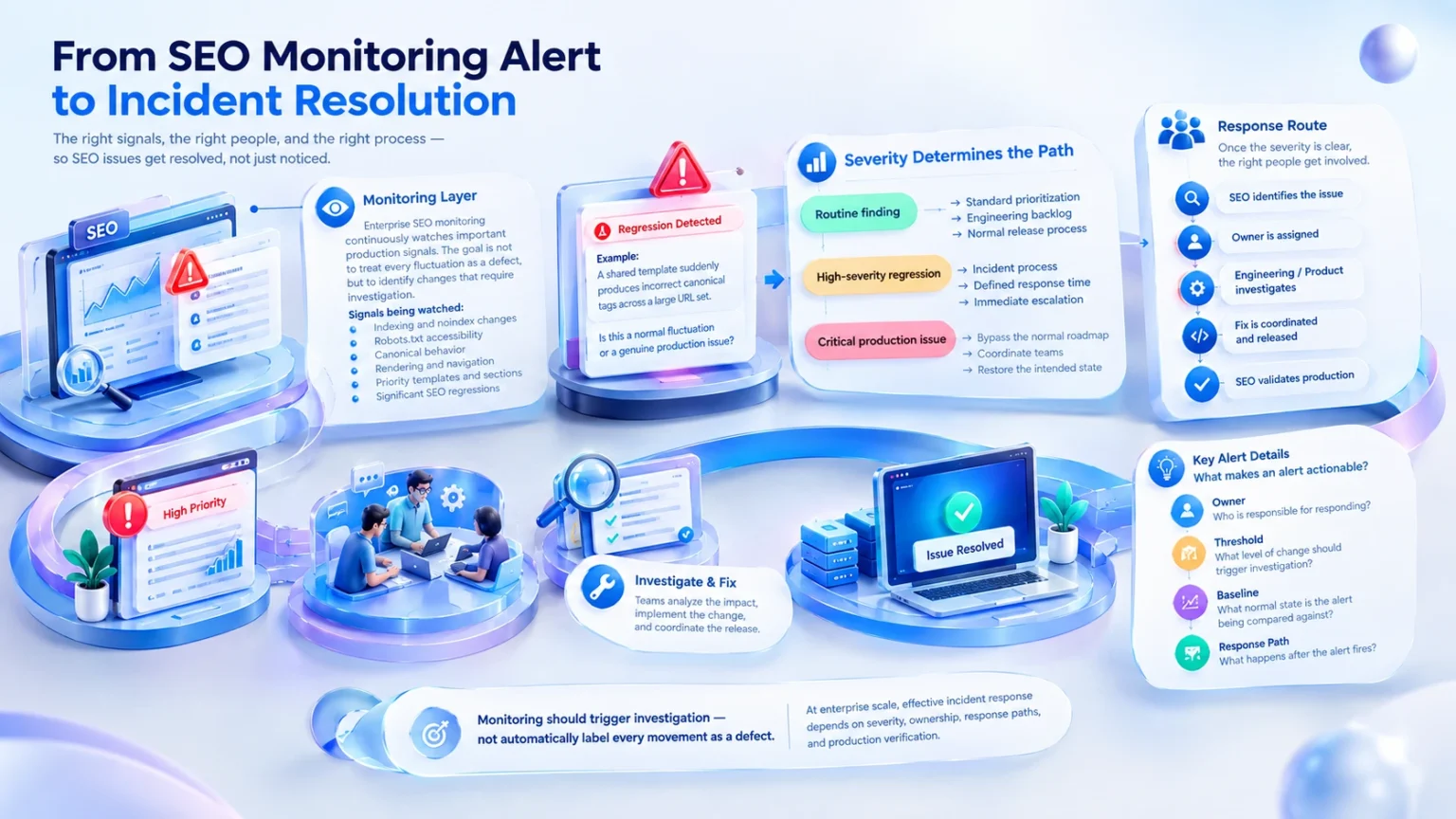
Not every SEO issue belongs in the standard prioritization queue. A high-severity regression, an accidental noindex, a production robots block, a canonical regression across a shared template, a navigation or rendering failure affecting a priority section, is better handled through an incident process with a defined severity, an expected response time, and an escalation route than left to wait for the next roadmap cycle. Escalation should be triggered by severity, not by how many times someone has had to follow up informally.
For monitoring itself to stay useful rather than becoming background noise nobody checks, each alert needs an owner, a threshold, a response path, and a baseline it’s actually being compared against; a dashboard nobody is accountable for tends to get ignored regardless of how good the underlying data is.
The following is an illustrative, composite scenario built from patterns Growzify sees across enterprise reviews, not a specific named client or a real audit result.
Suppose an in-house SEO at a multi-brand retailer identifies that a shared product template is generating incorrect canonical tags across one brand’s catalog specifically. On a small site, this could plausibly be a same-day fix. Here, the template is owned by a platform engineering team shared across all the company’s brands, which means any change needs to be tested against every brand using that template, not just the one affected.
Getting the fix scheduled would likely mean framing it not as “a canonical tag is wrong” but as a specific, scoped change request with acceptance criteria defining which brand’s URL cohort should change, which brands should remain unaffected, and the expected canonical output for each, coordinated against the platform team’s own release calendar.
Testing would need to run in both directions: confirming the affected brand’s canonical tags corrected as intended, and confirming the unaffected brands’ existing canonical behavior stayed untouched.
The technical diagnosis itself may take less time than the organizational work required to ship it, but the work isn’t complete when engineering merges the change; the affected cohort still needs verification in production against the original acceptance criteria before the issue is actually closed.
Treating a correct diagnosis as the finish line.At enterprise scale, identifying the problem is often the easy part; getting it actually implemented and verified in production is where most of the real work happens.
Underestimating how much of the job is translation, not analysis.A technically accurate finding that nobody outside SEO can act on doesn’t move anything forward.
Trying to skip building institutional relationships.Knowing who owns what, and having enough credibility to get a request prioritized, takes sustained effort and doesn’t come from technical skill alone, though a documented ownership map reduces how much the whole program depends on any one person’s memory.
Auditing on a fixed schedule and assuming that’s sufficient.Frequent release activity at enterprise scale means regressions can appear between scheduled reviews; ongoing monitoring at a cadence matched to release pace can identify important regressions earlier than a fixed audit schedule alone.
Internal ownership tends to be enough when the team already has engineering capacity, documented SEO requirements, a working ownership map, and executive support for prioritizing SEO work against other engineering demands.
Specialist support tends to add real value on top of that internal ownership when there’s a large, unresolved technical backlog, a major migration or replatform coming, an issue spanning multiple platforms or CMSs, a need for independent validation on a high-stakes change, engineering that needs implementation-ready specifications the internal team doesn’t have bandwidth to write, a gap in specialist technical depth, a temporary capacity need, or a pattern of recurring regressions that points to a governance gap rather than a one-off mistake.
External support can’t substitute for what has to exist internally regardless: an accountable owner, engineering capacity to actually ship the fix, and executive backing to prioritize it.
It’s different rather than simply harder. Lumar’s survey of digital leaders at enterprise-scale organizations found execution and monitoring at scale, and coordination across multiple departments, ranked as bigger reported challenges than general fixes to existing SEO problems. The skill set shifts toward organizational navigation and cross-functional coordination alongside technical expertise, not instead of it.
At enterprise scale, the systems that need to change, shared templates, CMS platforms, deployment pipelines- are frequently owned and maintained by separate engineering or platform teams. The SEO identifies and scopes the fix; implementation often depends on another team’s release cycle rather than the SEO’s own, though some organizations do grant SEO direct access to specific systems.
One of the biggest operational differences is the separation between diagnosis and implementation. A small-site SEO can often implement a fix themselves within the same day. An enterprise in-house SEO usually has to get that fix prioritized, scheduled, and implemented by a separate team, which changes a meaningful share of the actual daily work from technical execution to internal coordination and communication.
No, it’s still the foundation the rest of the work depends on. What changes is that technical skill alone isn’t sufficient; the ability to translate findings for non-SEO stakeholders and navigate organizational structure becomes equally necessary to get anything actually implemented.
It’s a parallel, ongoing responsibility alongside project work, not a replacement for periodic audits. Releases and content changes happen frequently at enterprise scale, so watching for regressions at a cadence matched to that release pace can identify important regressions earlier than a fixed audit schedule alone.
When the intended production state has been validated, not when the code merges. A staging pass and a merged pull request both confirm intent; production verification against the original acceptance criteria is what confirms the fix actually shipped as intended.
The coordination and execution challenges that define day-to-day in-house enterprise SEO work are exactly why prioritization matters so much at this scale; Growzify’s guide onbuilding an SEO roadmap for a large websitecovers how to turn a backlog of findings into a sequence that actually survives contact with competing business priorities. The release-validation and production-verification discipline referenced throughout this guide connects directly to Growzify’s guides on pre-deployment SEO checks and enterprise canonical governance.
If your organization’s in-house team is spending more time coordinating fixes than actually shipping them, Growzify’senterprise SEO servicesteam can work alongside your existing structure to help move priority findings through the process faster.

Chitranshu SharmaA growth strategist, digital marketing consultant, and the founder of Growzify, a performance-driven agency helping brands dominate search, shape perception, and build sustainable online visibility. With 8+ years of hands-on experience in Enterprise SEO, Online Reputation Management (ORM), and AI-led traffic generation, Chitranshu has helped startups, public figures, SaaS companies, and cannabis brands outrank competitors — ethically and at scale.

At Growzify, we are dedicated to helping your business achieve its goals. Are you Ready to take the next step?
Call Now






Growzify digital team is very effective, and easy to work with. Very strong communication and always up for suggestions. Saw 300% growth in web traffic 170% growth in revenue through Facebook ad’s & Amazon. I recommended them to my fellows and they turned their online business into a money making machine.