When Should You Outsource SEO? 11 Signs It Makes Sense
When Should You Outsource SEO? 11 Signs It Makes Sense...
Read More →
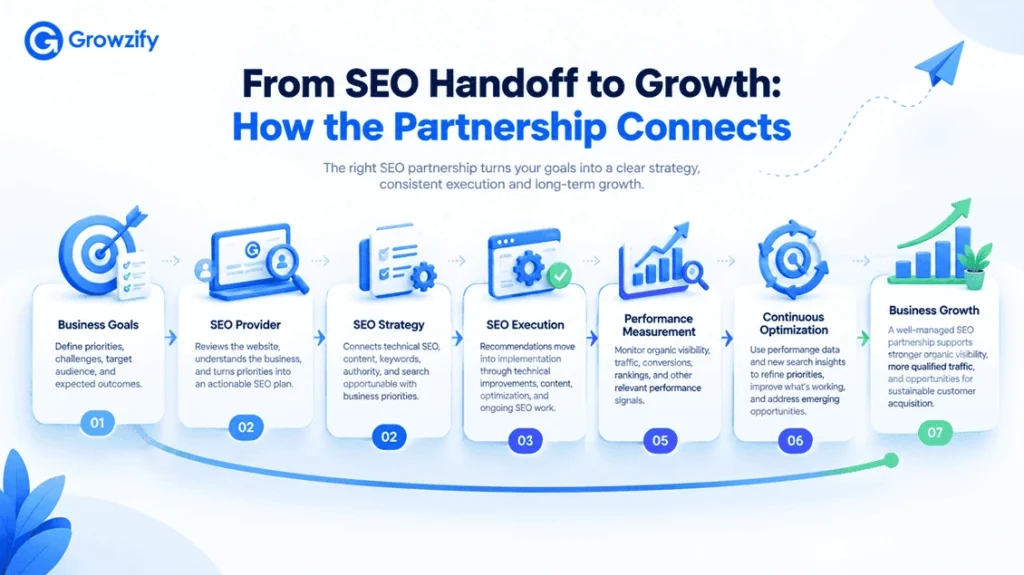
SEO handoffs can lose momentum before the work properly starts when access, historical context, a starting baseline, goals, and decision responsibilities haven’t been prepared in advance. A handoff is a transfer of access, context, measurement, and decision authority, not just a transfer of work.

An SEO outsourcing checklist is the set of things a business should have ready before handing SEO work to an outside provider: scoped platform access (Search Console, analytics, CMS), documentation of past SEO work and known issues, a captured performance baseline, clearly defined goals with agreed KPI definitions, a scoped budget with explicit exclusions, one accountable internal owner with clear decision rights, and a vetted provider whose actual practices have been checked before signing anything.
Methodology:This guide draws on Google Search Central’s own documentation on Search Console property ownership and permissions, and its separate guidance on evaluating an SEO provider, plus recurring onboarding patterns Growzify observes when businesses hand off SEO for the first time. Statements attributed to Growzify are practitioner observations, not universal guarantees, and the composite example later in this article is illustrative rather than a specific client case.
A provider can only work as fast as the access, information, and decisions coming from the client side. When those are missing on day one, the first few weeks of an engagement get spent chasing logins and clarifying scope instead of doing SEO work.
That delay compounds. Without Search Console access, a provider can still begin a public-facing SEO audit, but it can’t properly review the site’s historical Google Search performance, query data, indexing reports, or other property-specific Search Console information.
A provider without a clear success definition can’t tell the client whether month two looks good or concerning. None of this is really about the provider’s skill; it’s about whether the handoff gave them what they needed to start.
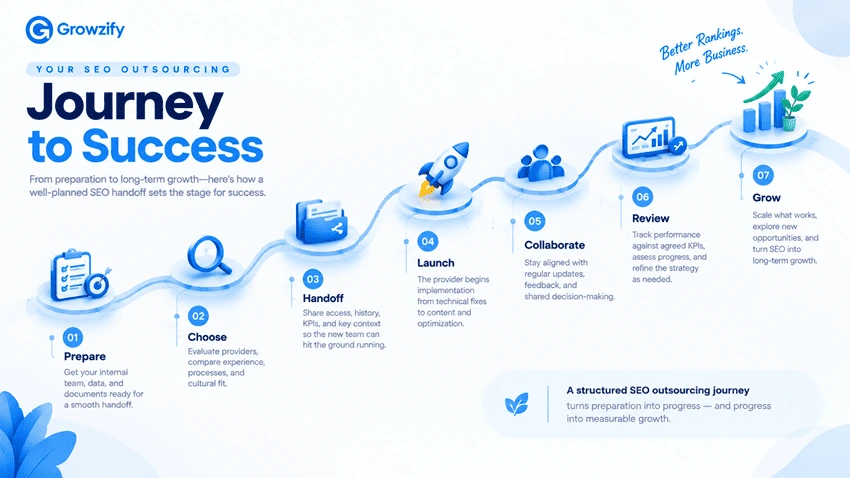
A useful way to hold the full checklist together: access, history, a captured baseline, goals, scope, decision authority, a vetted provider, ongoing governance, and continuity if the relationship ever ends. The sections below work through each piece.
This is the most concrete item on the list, and the easiest to get wrong by granting either too little or too much. The goal isn’t simply giving the provider access; it’s knowing who can access each system, why they need it, what permission level they hold, and how that access gets removed later.
Search Console and analytics access.Google’s Search Console documentationdefines four access types: Restricted, Full, Owner, and Associate, each with different rights. Separately,Google’s own guidance on evaluating an SEO providerrecommends granting only read access during an initial audit or provider evaluation rather than defaulting to ownership; these are two different Google resources making related but distinct points. Use the lowest permission level appropriate for the task, and increase it only if ongoing work genuinely requires actions available solely to a Full user or Owner. Where a platform supports individual named users or role-based access, add the provider as a named user rather than sharing a business owner’s personal login credentials.

Keep core property ownership business-controlled.A Search Console property needs at least one verified owner, or nobody retains access at all, and Google’s own documentation notes that as long as a removed owner’s verification token remains in place, that person can re-verify ownership even after being removed as a user.
Keep at least one verified owner under a business-controlled account rather than making an outside provider the sole verified owner, and if a previous provider ever had owner-level access, check both the current user list and any leftover verification tokens during handoff, not just the visible user list.
CMS access, scoped to what the work needs. A provider preparing content may need no CMS access at all if drafts are handed to an internal team for publishing. If the provider is responsible for uploading or publishing directly, grant the appropriate editor or publishing role rather than full administrative access unless administration is genuinely required.
Anything else the work touches.Depending on scope, this might include Google Business Profile, DNS or hosting if technical changes are involved, or a tag management platform. List these upfront rather than discovering the gap mid-engagement.
For every system granted, it’s worth tracking who has access, what permission level, who approved it, when it was granted, when it should be reviewed, and how it gets revoked, whether or not a business uses formal access-management software to do it. A simple rule worth applying across all of it: grant the least access a task genuinely requires, and revisit permissions if the scope changes later.
Before a new provider changes anything, it’s worth preserving what the account looked like at handoff. Depending on the engagement, that can include a Search Console performance export, a GA4 organic acquisition and conversion baseline, performance for the most important landing pages, a defined tracked-query set if one is used, the current index and canonical state of priority pages, active XML sitemaps, any significant redirect rules already in place, known technical issues, and current lead or revenue measurement setup.
The purpose isn’t to build a perfect archive, or to assume every future change in performance was caused by the new provider. It’s to give both sides a shared starting point that later movement can actually be diagnosed against, rather than reconstructing what the account looked like months after the fact.
“Improve our SEO” isn’t a scope a provider can work against. Before handoff, it’s worth deciding what specifically matters and separating a few different kinds of measures rather than treating them as interchangeable.
Business outcomes, qualified leads, sales, bookings, or trials, are what ultimately matter commercially. Understanding how differentSEO metrics connect to these outcomesis also important when defining success.
Search outcomes, organic clicks, visibility for relevant queries, traffic to high-value landing pages, describe what changed in search itself.
Delivery indicators, technical fixes shipped, content published, links earned, are evidence that work happened, not automatic evidence that it moved the business outcomes. Completed SEO work is evidence of delivery; it isn’t automatically evidence of business impact.
For each KPI that matters, agree on its actual definition before work starts, not just its name. “Organic leads” only works as a shared success measure if both sides know which form submissions or events count, which analytics or CRM field is the source of truth, and whether attribution is first-touch, last-touch, or assisted.
“Rankings” needs an agreed query set, location, and device, since a rank tracker and Search Console can report meaningfully different numbers for what sounds like the same thing. Agreeing that leads or rankings matter isn’t enough if the two sides later discover they were counting them differently the whole time.
It’s also worth agreeing on a review horizon for evaluating progress, while recognizing upfront that neither the timing nor the magnitude of ranking and traffic changes can be guaranteed by any provider.
None of this needs to be a formal document. It needs to exist somewhere both sides can refer back to later, since the absence of a written, clearly defined goal is exactly what turns an ambiguous outcome into a disagreement three months in.
Decide, before talking to a provider, roughly what’s in scope and what isn’t: is this technical work only, content only, or the full range including link building? Is there a hard monthly ceiling, or a per-project structure?
The scope is just as useful for what it explicitly excludes, development implementation, copywriting, digital PR, local SEO, migration work, or paid media, for example, so neither side quietly assumes the other team owns it.
A budget without a scope attached tends to produce vague, catch-all proposals. A scope without a realistic budget attached tends to produce a plan that gets cut down mid-engagement once the real cost becomes clear. Settling both together, even roughly, gives a provider something concrete to respond to.
Scope almost always changes at some point, so it’s worth agreeing upfront how an out-of-scope request gets approved, priced, and scheduled, rather than letting informal requests quietly become permanent unpaid scope over time.
Growzify’sdetailed cost comparison between an in-house SEO team and outsourced deliverywalks through that math in depth for agencies weighing the same delivery-model decision for their own client work; the underlying cost logic (fixed team cost versus usage-linked outsourced cost) applies to any business, even though that specific guide is written for an agency audience.
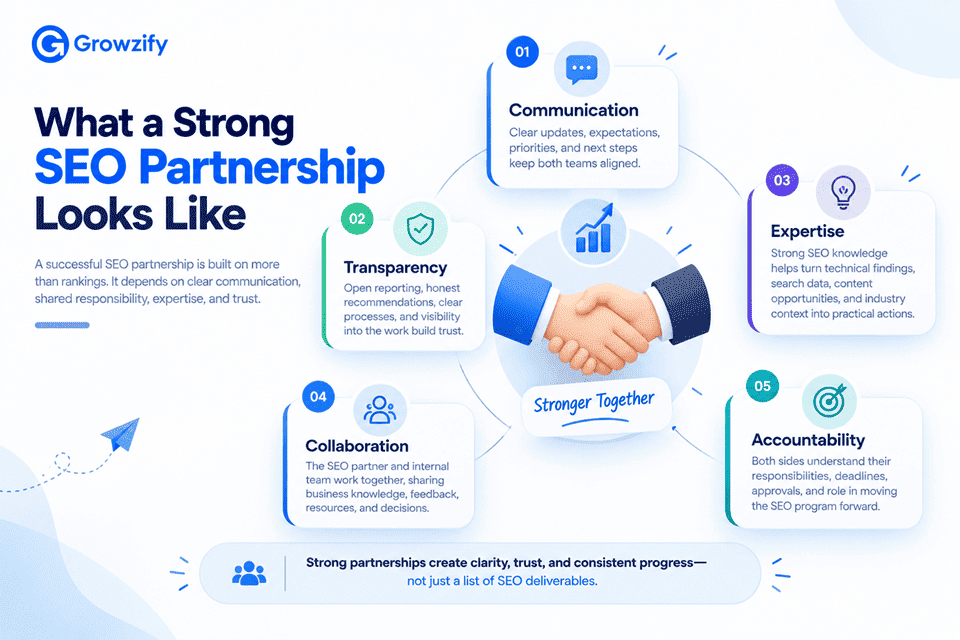
Every engagement should have one clearly accountable internal owner who coordinates decisions and knows which stakeholders need to sign off on which type of work. Without that, decisions stall in internal email threads while the provider waits. Technical, legal, budget, or brand changes may still need separate approvers; the owner’s job is knowing who those people are, not personally approving everything.
That person doesn’t need deep SEO expertise personally. They need enough context to flag when a recommendation doesn’t fit the business, the availability to review deliverables on a predictable cadence, and a clear map of who else needs to weigh in on higher-stakes changes. Growzify’swhite label SEO quality control checklistcovers what that ongoing review should actually check once deliverables start arriving, which is useful preparation reading even before the engagement begins.
For important work, it helps to define four roles explicitly rather than leave them implied: who recommends an action, who approves it, who implements it, and who validates that it was actually done correctly. A recommendation shouldn’t count as complete just because it was sent to someone.
| Work type | Recommends | Approves | Implements | Validates |
| Redirect or technical change | Provider | Internal owner or dev lead | Provider or in-house developer | Provider |
| Content piece | Provider | Brand or subject-matter reviewer | Provider or internal CMS team | Agency or client |
| Tracking or analytics change | Provider or analytics owner | Internal owner | Analytics or dev team | Both sides |
Where a provider can make live technical changes, it’s worth clarifying upfront who approves those changes and whether staging, backups, or a rollback plan are required before anything ships to production, and confirming an implementer and a validation step so a change isn’t recorded as done simply because it was sent somewhere. A workstream is genuinely ready to start once the provider has the access, context, authority, and any dependency it needs, not before.
If the business handing off SEO is itself an agency reselling the work to its own clients, this ownership question gets a layer more complex, since someone still needs to review deliverables before they reach the end client. Growzify’swhite label SEO servicesare built specifically for that structure, where an agency keeps the client relationship, and Growzify handles execution behind the scenes.
A provider starting from zero context re-does work that already exists somewhere, usually slower and less accurately than if the history had just been shared.
Worth gathering before handoff, where relevant or known:
None of this needs to be perfectly organized. A messy folder of old reports is still more useful to a new provider than no folder at all, since even an outdated audit tells a new provider what’s already been tried, what was fixed, and what was left unresolved on purpose versus by oversight.
It’s also worth flagging anything sensitive upfront: a pending rebrand, a planned platform migration, or a legal or compliance review process content has to clear. A provider who doesn’t know a migration is six weeks out might recommend changes that get overwritten the moment it happens.
Where a new provider is replacing an old one, review what the previous provider still owns or can access: Search Console ownership, GA4 users, Google Business Profile, CMS accounts, hosting, DNS, rank trackers, dashboards, and any shared documents, rather than assuming that relationship’s access ended cleanly on its own.
Handoff preparation isn’t only about what the client organizes internally; it includes checking the provider’s actual practices before signing anything.Google’s own guidance on evaluating an SEO provideris a useful starting point, and it specifically recommends asking for examples of past work, checking whether a provider’s methods align with current guidance, and being cautious of guarantees no provider can actually make, since no one controls how Google ranks a specific page.
A few direct questions are worth asking before signing: can they show recent, comparable work for a similar business; what exactly happens in the first 30 days after handoff; who will actually perform the work, and are subcontractors involved; and what they need from the client to get started, which should roughly match the access and documentation list above.
A provider who can’t answer that last question clearly is a sign the relationship may start the same way a poorly prepared client engagement does, with weeks lost to figuring out logistics.
If a provider sells AEO or generative-engine optimization to improveAI-search visibility in overviews and LLMs as part of the package, it’s also worth asking which recommendations are grounded in official platform guidance, which come from the provider’s own testing, and which metrics come from third-party monitoring tools, since those are different levels of certainty worth knowing apart.
It’s also reasonable to ask how the provider handles a scope change mid-engagement, what reporting actually looks like month to month, and how they handle data and account security, who on their side gets access, where credentials are stored, and how access is revoked when the engagement or a specific staff member’s involvement ends.
Neither answer needs to be elaborate, but a provider who’s never had to think about any of these is likely newer to structured client work than their pitch suggests. Growzify’sguide to key questions before choosing a white label SEO partnercovers this vetting conversation in more depth.
Granting access the moment the contract is signed, without scoping it.Defaulting to full administrative access “to make things easier” creates unnecessary risk and makes it harder to track who changed what later. Scope access to the agreed work first, and expand it deliberately if the relationship grows.
Treating the kickoff call as the first time goals get discussed.Walking into onboarding without an internal answer to “what does success look like” tends to produce a generic strategy that reflects the provider’s default approach rather than the business’s actual priorities.
Assuming the provider will ask for everything they need.A good provider will ask good questions, but they can’t ask about a site migration or a prior agency relationship they have no reason to know existed. Volunteering known history upfront is faster than waiting to be asked. A mature provider should be able to hand over an onboarding requirements list before kickoff rather than discovering every dependency ad hoc; if they can’t, that’s informative too.
Skipping internal alignment on decision authority.If the person approving budget, the person reviewing technical recommendations, and the person managing the day-to-day relationship are three different people who haven’t agreed on who decides what, the provider ends up managing internal politics instead of doing SEO work.
Choosing a provider before defining scope.Evaluating providers against a vague sense of “we need SEO help” makes every pitch sound reasonable. Defining scope first, even roughly, makes it much easier to tell which provider’s approach actually fits.
Letting the provider hold the only copy of the baseline.If historical performance data, access records, and campaign context live exclusively inside the provider’s own systems, that history can effectively disappear if the relationship ends. Keep business-controlled access to source data and core accounts throughout the engagement, not just at the start.
There’s no universal timeline, but the work tends to fall into a few natural stages: settling scope and validating a provider before signing anything; gathering access, documentation, and a baseline before kickoff; agreeing goals, roles, and communication at kickoff itself; confirming approvals and any staging or rollback requirements before implementation begins; and checking that data sources, baselines, and KPI definitions actually line up once the first reporting cycle arrives.
For a straightforward small or mid-sized engagement, Growzify often treats this as a relatively light preparation exercise rather than a separate project. More complex sites, multiple internal stakeholders, legacy access issues, or compliance requirements can make preparation materially longer.
The businesses that skip this preparation usually aren’t doing so because it’s genuinely time-consuming relative to their situation; the urgency to start often outweighs the instinct to prepare. In Growzify’s experience, that trade-off frequently means the same access and context questions resurface anyway, just later, once the engagement is already underway.
| Area | Ready when… |
| Access | Named users and the minimum required permissions are mapped for every relevant platform |
| Ownership | The business retains at least one verified owner on core accounts and properties |
| Security | MFA, access review timing, and a revocation process are defined where relevant |
| History | Audits, migrations, known issues, and other material prior work are gathered |
| Baseline | Starting search and business performance has actually been captured, not just assumed |
| Goals | Business outcomes and search outcomes are both written down |
| Measurement | KPI sources and definitions are agreed, not just KPI names |
| Scope | What’s included and explicitly excluded is written down |
| Authority | Who recommends, approves, implements, and validates each workstream is known |
| Change control | Out-of-scope work has a defined approval and pricing path |
| Provider | Methods, past examples, actual personnel, and subcontracting have been checked |
| Governance | Communication cadence, reporting format, and escalation path are agreed |
| Continuity | The business retains data, account ownership, and the ability to revoke access if the relationship ends |
The following is an illustrative, composite scenario built from patterns Growzify sees during SEO handoffs, not a specific named client or a record of measured timings.
Consider a mid-sized retail brand that decided to outsource SEO for the first time after years of managing it loosely in-house. The business signed with a provider quickly, motivated by a competitor’s recent visibility gains, without preparing much beyond a verbal “help us rank better.”
The opening phase was consumed by logistics: the provider didn’t have Search Console access because nobody remembered which employee account originally set it up, there was no record of a site migration from roughly a year and a half earlier that had quietly broken several redirects, and no one internally had the authority to approve the provider’s first round of recommended changes without escalating to a director who was traveling.
Once access was sorted and the migration history surfaced, the actual technical assessment moved much faster. The delay hadn’t been a provider capability problem; it had been a preparation problem.
None of these 11 signs individually forces a decision. Together, they’re a way to name what’s actually happening internally: a skills gap, a capacity gap, a speed gap, an economics gap, or a strategy and diagnostic gap, rather than reacting to a vague sense that SEO should be doing better.
Once the gap is named, the right response might be outsourcing, hiring, fixing an internal process, or a hybrid of the three. If several of these signs sound familiar, Growzify’sSEO outsourcing servicesteam can help figure out exactly which gap applies and what scope of support would actually close it.
If the business weighing this decision is itself an agency deciding whether to resell SEO under its own brand rather than deliver it directly, Growzify’swhite label SEO servicesteam is the more relevant starting point instead.
There’s no single universal item, but access to first-party performance data and one accountable internal owner are usually the highest-leverage prerequisites. Without data, the provider loses historical context; without a clear owner, decisions can stall even when the data is perfect.
Not by default. Grant the lowest permission level that supports the agreed task, use named user accounts where the platform allows it, and increase access only when the work genuinely requires it. Keep at least one verified owner on core accounts under business control regardless of what else is granted.
Preserve current Search Console and analytics baselines, previous reports and audits, a record of major changes, key rankings or query sets if used, unresolved technical issues, and a list of who currently has access to which platforms and accounts. The goal is continuity, not building a perfect archive.
Do I need a formal document, or is a rough list enough?
A rough, written list is enough. What matters is that it exists somewhere both sides can reference, not that it’s polished. An unwritten goal is far more likely to become a disagreement later than a messy one that’s actually documented.
Only what the agreed scope requires. A provider responsible for ongoing publishing may need editor or publisher permissions, but not necessarily full administrator access. Start narrow and expand access if the scope changes.
Share whatever exists, even if it’s incomplete or outdated. A partial history is still more useful than none, and a competent provider can fill gaps with their own audit once they understand what’s already known versus unknown.
Not necessarily, but someone needs clear authority to approve scope-appropriate work without a lengthy internal approval chain. Splitting budget authority and technical review between two people is fine as long as both are actually available and responsive.
Ask what they need from you to start, and how specific the answer is. A provider who can immediately list the access, documentation, and goals they need has clearly done this before; a vague answer suggests the first few weeks may be spent figuring out logistics on their end too.
Yes, and it’s worth confirming upfront how that works. Individually assigned platform access, rather than a single shared login, makes it straightforward to revoke a specific provider’s permissions without disrupting anyone else’s access when an engagement ends.
A shorter or smaller engagement still benefits from a scaled-down version of the same list, access, a rough goal, and one point of contact. The specific items matter less than making sure the provider isn’t starting from zero information, regardless of project size.
A good SEO outsourcing engagement is decided well before the first deliverable arrives. Preparing access, history, a captured baseline, goals, budget, and internal ownership doesn’t guarantee SEO results, but it reduces avoidable onboarding friction and gives the provider better information to work from at the start.
If you’re getting ready to hand off SEO and want a partner who can move past the logistics quickly, Growzify’sSEO outsourcing servicesteam can walk through exactly what’s needed on your side before work begins.

At Growzify, we are dedicated to helping your business achieve its goals. Are you Ready to take the next step?

Call Now






Growzify digital team is very effective, and easy to work with. Very strong communication and always up for suggestions. Saw 300% growth in web traffic 170% growth in revenue through Facebook ad’s & Amazon. I recommended them to my fellows and they turned their online business into a money making machine.