


Enterprise SEO Metrics: The KPIs That Actually Move Revenue
Enterprise SEO success depends on measuring the right KPIs. Discover how to evaluate visibility, traffic, conversions, revenue, and AI search performance to demonstrate real business value and growth.

Written byChitranshu Sharma
September 14, 2026
Quick Nav
Enterprise SEO metrics are the key performance indicators (KPIs) used to measure SEO's contribution to business growth. While rankings, impressions, and traffic remain important, enterprise organizations. These metrics provide a clearer picture of how SEO supports business objectives. These metrics provide a clearer picture of how SEO supports business objectives and helps leadership make informed investment decisions.
Enterprise SEO has become one of the most valuable long-term growth channels for large organizations. A well-executed SEO strategy increases brand visibility and attracts qualified prospects. Along with creating a sustainable customer acquisition without relying entirely on paid advertising. However, as enterprise SEO programs mature, the definition of success also changes.
Many SEO teams still focus their reporting around keyword rankings, impressions, clicks, and organic traffic. These metrics are useful because they indicate whether search visibility is improving. However, they only explain part of the story. Many business leaders view SEO differently.
A Chief Marketing Officer wants to understand whether SEO is generating qualified leads. Whereas a Chief Revenue Officer wants to know how much pipeline originated from organic search. A Chief Financial Officer is interested in revenue, return on investment, and customer acquisition costs.
That measurement gap is a common challenge.Gartner found that only 52% of senior marketing leaderscould successfully demonstrate marketing’s value and receive credit for their contributions to business outcomes.
For enterprise SEO, the solution is to connect the dots: search visibility, qualified traffic, conversions, pipeline, and then revenue.
This difference in understanding of the key metrics often creates a reporting gap. The SEO team celebrates an increase in organic traffic, while executives ask why revenue hasn’t changed. They simply measure different stages of the customer journey.
The most successful enterprise organizations bridge this gap by connecting SEO metrics to business outcomes. Instead of asking“How many people visited the website?”, they ask:
- How many qualified prospects did SEO generate?
- How much revenue came from organic search?
- Which landing pages influence pipeline?
- Is SEO reducing customer acquisition costs?
- What return are we getting from our SEO investment?
When SEO reporting answers these questions, it becomes far more valuable to executive leadership.
Let’s understand the enterprise SEO KPIs that matter most and which metrics are diagnostic versus revenue-focused. Along with how to build reporting that helps SEO teams prove and improve their business impact.
Why Enterprise SEO Metrics Matter
Every enterprise SEO strategy is built with one objective in mind: creating business value. While rankings, impressions, and clicks help measure search performance, they don’t always explain how SEO is influencing leads, sales, or revenue. Enterprise SEO metrics bridge that gap by connecting marketing performance with measurable business outcomes. Their objectives are much broader. Enterprise SEO supports:
- Brand awareness
- Demand generation
- Lead acquisition
- Ecommerce revenue
- Customer acquisition
- Market expansion
- Long-term business growth
Enterprise SEO metrics should do more than describe search performance; they should explain business performance. When your reporting connects visibility with leads, pipeline, revenue, and ROI, SEO becomes a strategic growth channel that leadership can confidently invest in. Because these goals directly influence business performance, SEO reporting must move beyond traditional search metrics.
Traditional SEO Metrics vs Business KPIs
Every SEO report contains numbers that tell a different story altogether. Some metrics help SEO teams understand how well a website is performing in search results. While others show executives whether those improvements are translating into real business outcomes. In reality, SEO metrics fall into two categories.
Traditional SEO Metrics
These metrics help SEO teams understand how search performance is changing. These metrics are essential because they identify opportunities and technical issues before they affect business performance. Examples include:
- Keyword rankings
- Organic impressions
- Organic clicks
- Indexed pages
- Click-through rate (CTR)
- Backlinks
- Crawl health
- Core Web Vitals
For example, A sudden change in indexed-page cohorts can justify investigation, but it should first be reconciled against intentional canonicalization, noindex rules, URL retirements, migrations, and reporting changes before being classified as a technical problem. Similarly, declining keyword rankings may explain a future decrease in leads. Many search and technical metrics can function as diagnostic or leading indicators when they are tied to an understood failure mechanism, but they should not automatically be treated as predictors of future revenue. They help teams detect problems early.
Business KPIs
These metrics demonstrate how SEO contributes to overall business performance. Executives focus on different questions. Instead of asking: “How many keywords rank on page one?” They ask: “How much business did SEO generate?” Important business KPIs include :
- Qualified leads
- Marketing-qualified leads (MQLs)
- Sales-qualified leads (SQLs)
- Organic conversion rate
- Pipeline generated
- Organic revenue
- Customer acquisition cost (CAC)
- Customer lifetime value (CLV)
- Return on Investment (ROI)
These metrics demonstrate how SEO contributes to overall business performance. Unlike rankings, they directly influence strategic planning, marketing budgets, and executive decision-making.
Are Rankings Really the Best Measure of SEO Success?
Seeing your website rank on the first page of Google is always encouraging. Higher rankings often mean better visibility, more clicks, and increased traffic. While rankings are an important indicator of search performance, they don’t reveal whether your website is attracting the right audience, generating qualified leads, or contributing to business growth. Enterprise SEO is ultimately about creating measurable business value, not just improving positions in search results. Here’s why. Imagine your website ranks first for a keyword that generates 50,000 monthly searches. Traffic increases dramatically. Where visitors are not qualified leads, sales remain unchanged, and you get fewer enquiries.
Now imagine another page ranks third for a highly commercial keyword with lower search volume. Although it receives fewer visitors, but get the qualified leads that are most ready to buy. The page generates significantly more leads and revenue. Which ranking is more valuable? The answer depends on business outcomes, not search volume.
Enterprise SEO isn’t about attracting the largest audience. It’s about attracting the right audience. For executive reporting, rankings are more useful when they are connected to qualified demand, pipeline, and revenue rather than reported in isolation.
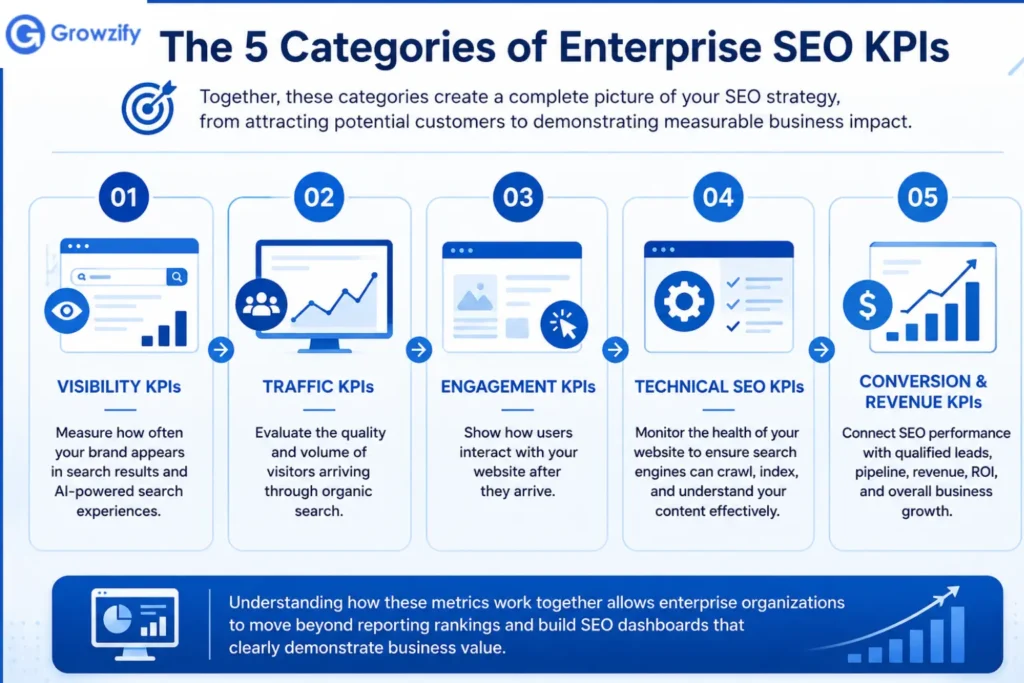
Not all enterprise SEO metrics measure the same aspect of performance. Some focus on how visible your website is in search results, while others evaluate user engagement, technical health, or business impact. To make reporting more structured and actionable, enterprise SEO KPIs can be grouped intofive key categories. Together, these metrics provide a complete view of how SEO contributes to sustainable business growth.
Visibility KPIs: Measuring How Discoverable Your Business Is
Before a customer visits your website, fills out a form, or makes a purchase, they first need to discover your business. Visibility KPIs measure how often your brand appears in search results and how effectively you’re capturing demand within your market.
For enterprise organizations, visibility isn’t about ranking for a handful of keywords. It means being present across thousands of relevant searches, product categories, service pages, locations, and informational queries throughout the customer journey.
Think of visibility as the top of the revenue funnel. If potential customers never discover your website, they can’t become leads or customers.
Organic Impressions
Organic impressions show how often your pages appear in search results, regardless of whether users click. Growing impressions mean the site is appearing more frequently in Search, but the cause may include greater query coverage, ranking changes, demand growth, new indexed inventory or other factors.
However, impressions should never be evaluated alone. Share-of-visibility is a modeled competitive metric, not a complete measure of market demand. Always document the tracked keyword universe and calculation methodology so leadership knows what the percentage actually represents.
For example:
A website may receive a great number of monthly impressions, but if those impressions come from irrelevant keywords, they contribute little business value. Instead, ask:
- Are impressions growing for commercial pages?
- Are high-value product categories gaining visibility?
- Are priority services appearing more often?
Quality matters more than volume.
Share of Search Visibility
Enterprise businesses compete against dozens or hundreds of competitors. Instead of measuring only your own rankings, measure your share of search visibility. This helps answer questions like:
- How visible is our brand compared to competitors?
- Which product categories are losing market share?
- Where are new competitors gaining visibility?
For CMOs, this provides a much clearer picture of market position than individual keyword rankings.
Brand vs Non-Brand Traffic
Brand and non-brand traffic reveal two different aspects of your SEO performance.While one measures how effectively your business reaches new audiences, the other reflects the strength of your brand recognition and customer loyalty. Tracking both separately provides a clearer understanding of your overall organic growth strategy.
Brand Searches:People already searching for:
- Your company
- Products
- Brand name
Example:
“Growzify Enterprise SEO” These visitors already know your business.
Non-Brand Searches
People searching for problems or solutions.
Example:
- Enterprise SEO Services
- AI SEO Agency
- Technical SEO Consultant
Growth in non-brand visibility often indicates expanding market reach and new customer acquisition. For acquisition-oriented SEO programs, qualified non-brand visibility and conversions are often important growth indicators.
AI Search Visibility
Search has changed significantly. Today businesses appear in:
- Google AI Overviews
- ChatGPT Search
- Perplexity
- Gemini
- Copilot
Enterprise discovery now occurs across traditional Search and generative search/assistant surfaces, so measurement increasingly needs to distinguish Google Search visibility from AI-assistant mentions, citations, and referral traffic. Organizations should monitor:
- AI citations
- Brand mentions
- AI-generated recommendations
- Featured sources
- Knowledge Graph visibility
These metrics show how frequently the brand or its content appears within a defined set of AI-generated answers; they should not be interpreted as a platform-issued authority score.
Traffic KPIs: Measuring Qualified Visitors
Traffic remains one of the most widely reported SEO metrics. However, enterprise organizations should focus less on how many visitors arrive and more on who those visitors are. A million visitors provide little value if none become customers.
Organic Sessions
Organic sessions measure how many visits originate from search engines. This remains an important KPI because it reflects overall search performance. However, enterprise reporting should segment traffic by:
- Product pages
- Service pages
- Blog content
- Location pages
- International websites
This provides much more actionable insights.
Commercial Page Traffic
One of the most valuable KPIs enterprise organizations can track is: Organic traffic to commercial pages. These include:
- Product pages
- Pricing pages
- Service pages
- Comparison pages
- Solution pages
Unlike blog traffic, visitors reaching these pages are often much closer to making a purchasing decision.
New vs Returning Visitors
Understanding where your organic visitors come from is only part of the story. It’s equally important to know who they are. Tracking new and returning visitors helps enterprise SEO teams measure brand discovery, customer interest, and how effectively the website encourages users to come back. Enterprise reporting should distinguish between:
New Visitors: People discovering the business for the first time. Growth here indicates expanding market reach.
Returning Visitors:Visitors continuing their buying journey. Compare new and returning users to understand whether organic search primarily introduces new audiences, supports repeat research, or contributes across both stages. Do not assume one group is more valuable without site-specific conversion data. Tracking both provides insight into awareness and customer consideration.
Engagement KPIs: Measuring User Quality
Visibility attracts visitors. Engagement determines whether they stay. Because SEO continues generating traffic long after content is published, its long-term acquisition cost often becomes significantly lower than paid advertising. Enterprise organizations should therefore measure whether users actually interact with their content.
Engagement Rate
Instead of focusing only on bounce rate, monitor engagement. Questions include:
- Did visitors read the page?
- Did they explore additional content?
- Did they interact with calls-to-action?
Engagement metrics need to be interpreted against page purpose. A long research guide may reasonably generate extended engagement, while a pricing or contact page can succeed through a short, efficient visit that converts.
Average Engagement Time
Time spent on important commercial pages often reveals whether visitors are evaluating your products or leaving immediately.
Longer engagement generally indicates stronger interest. However, context matters. A pricing page may convert quickly. A buying guide may naturally require longer reading.
Internal Navigation
Enterprise websites often contain thousands of pages. Monitor whether visitors continue exploring after landing.
Examples: This path provides evidence that an organic landing session participated in a commercial journey and is worth connecting to downstream lead and CRM data.
Engagement metrics bridge the gap between traffic and conversions. They reveal whether users are exploring your content, interacting with key pages, and moving closer to taking action. By monitoring these KPIs, enterprise teams can continuously improve user experience while increasing the likelihood of generating qualified leads and revenue.
Technical SEO KPIs
Technical SEO KPIs help maintain a strong foundation for enterprise SEO by measuring your website’s overall health and performance. Regularly tracking these metrics ensures search engines can efficiently crawl, index, and understand your content, supporting better visibility, user experience, and long-term organic growth.
Indexed Pages
What you need to Monitor:
- Total indexed URLs
- Important pages excluded
- Duplicate pages
- Unexpected indexing changes
Large fluctuations often indicate technical problems.
Crawl Health
Search engines should efficiently discover important pages.
Track:
- Crawl errors
- Redirect chains
- Broken links
- Server errors
Crawl and indexation anomalies can become early evidence of a technical regression when they affect important URL cohorts, but raw error counts should be interpreted by URL importance and expected behavior.
Core Web Vitals
Fast websites improve both user experience and business outcomes.
Monitor:
- Largest Contentful Paint (LCP)
- Interaction to Next Paint (INP)
- Cumulative Layout Shift (CLS)
These metrics help identify performance issues affecting thousands of pages.
Structured Data Coverage
Structured data provides machine-readable information that Google Search can use to understand page entities and determine eligibility for supported rich results. Its treatment by other AI platforms varies and should not be assumed to work identically.
Track:
- Valid schema
- Schema errors
- Rich result eligibility
- Entity coverage
Well-maintained structured data can support Google rich-result eligibility and cleaner machine-readable entity information, but it does not guarantee higher visibility or AI citations.
Visibility, traffic, engagement, and technical health remain essential enterprise SEO metrics because they reveal how effectively your website attracts and serves potential customers. However, these metrics are only part of the picture. They explain what is happening, but they don’t fully explain how SEO contributes to business growth.
Technical SEO metrics should be viewed as proactive indicators rather than reactive fixes. Monitoring them consistently helps prevent indexing, crawling, and performance issues before they affect visibility, traffic, and ultimately business growth.
In the next section, we’ll explore the KPIs that matter most to executive leadership, includingqualified leads, pipeline, revenue, customer acquisition cost, SEO ROI, and AI search metricsthat directly connect SEO performance to measurable business outcomes.
Conversion & Revenue KPIs: Metrics That Executives Care
Visibility, traffic, and engagement tell you whether your SEO strategy is working. Conversion and revenue KPIs tell you whether your SEO investment is generating business value. This is where SEO reporting becomes meaningful to CMOs, CFOs, and executive leadership.
Unlike SEO specialists, executives rarely ask: “How many keywords moved into the top three positions?” Instead, they ask:
- How many qualified leads did SEO generate?
- How much pipeline came from organic search?
- Did SEO reduce our customer acquisition cost?
- What’s the return on our SEO investment?
These are the metrics that justify marketing budgets and influence future business decisions.
Qualified Leads from Organic Search
One of the strongest indicators of SEO success is the number of qualified leads generated through organic search.
Unlike traffic, qualified leads represent visitors who have shown genuine buying intent by:
- Requesting a demo
- Booking a consultation
- Completing a contact form
- Starting a free trial
- Requesting a quote
These actions demonstrate that SEO is attracting the right audience rather than simply increasing visitor numbers.
Example
Suppose an enterprise cybersecurity site intentionally removes a cohort of obsolete informational pages. In the following quarter, total organic sessions decline while demo requests and sales-qualified opportunities from commercial landing pages increase.
That outcome would justify examining whether traffic quality improved, but the change should not automatically be attributed to content removal without controlling for seasonality, ranking changes and other releases. However:
- Demo requests increased
- Sales enquiries increased
Although traffic declined, SEO became significantly more valuable because it attracted higher-intent visitors.
Organic Conversion Rate
Organic conversion rate measures how effectively visitors arriving through search complete meaningful business actions.
Organic conversion rate = qualifying organic conversions ( divided by ) relevant organic sessions/users
Examples include:
- Purchasing a product
- Downloading enterprise resources
- Booking product demonstrations
- Contacting the sales team
- Starting a subscription
A website attracting fewer visitors but converting them at a higher rate often delivers Greater business value than one generating large volumes of low-quality traffic.
Revenue from Organic Search
One of the most important enterprise SEO KPIs isorganic revenue. Organic revenue is not a single universal measurement. It can mean revenue assigned to organic search under the organization’s selected attribution model, first-touch revenue from users initially acquired through organic search, last-touch revenue, or revenue associated with opportunities that included an organic touchpoint. The report must state which definition it uses. For ecommerce businesses, this is relatively straightforward.
For B2B organizations, CRM integration often connects:
- Search traffic
- Marketing automation
- CRM
- Sales pipeline
- Revenue attribution
This gives leadership a traceable view of organic touchpoints and downstream business outcomes, subject to the attribution model and tracking limitations.
Example
An enterprise SaaS company discovered:
- Organic traffic contributed to website sessions.
- However, it generated better new customer revenue.
Although paid advertising delivered more visitors, if CRM data showed a higher win rate or lower CAC for customers attributed to organic under the same measurement model
Organic-Sourced Pipeline
For most B2B organizations, revenue isn’t generated after a single website visit. The buying journey typically unfolds over several stages. A potential customer may first discover your business through organic search, visit a solution page to learn more, submit a demo request, become a Sales Qualified Lead (SQL), progress into a sales opportunity, and eventually convert into a closed customer. Understanding this journey helps businesses measure how SEO contributes to revenue beyond the first click.
Tracking the sales pipeline generated or influenced by organic search helps leadership understand SEO’s contribution throughout the buying journey.
Instead of measuring only leads, organizations can calculate:
- Pipeline value
- Opportunity creation
- Sales influence
- Closed revenue
This provides a much clearer picture of SEO’s commercial impact.
Customer Acquisition Cost (CAC)
Customer Acquisition Cost measures how much it costs to acquire one customer. Most organizations compare CAC across channels.
SEO CAC = eligible SEO program cost ( divided by ) customers attributed to SEO under the defined methodology.
Ensure equivalent cost scopes when comparing SEO CAC with paid channels.
For example:
- Paid Search
- Paid Social
- Email Marketing
- Events
- Organic Search
SEO can continue generating demand from previously created assets, but its CAC should be calculated from actual program cost and attributable customer outcomes rather than assumed to be lower than paid media. Tracking SEO-driven CAC helps marketing leaders demonstrate long-term efficiency.
How to Build an Enterprise SEO Measurement System
Tracking individual SEO metrics is valuable, but real business insights come from measuring them as part of a structured system. An enterprise SEO measurement system connects visibility, traffic, engagement, and conversions into one framework. Helping teams understand performance, identify opportunities, and make confident, data-driven business decisions.
Step 1: Define the business outcome
What does the company want SEO to accomplish?
Step 2: Define meaningful conversions
Don’t treat every pageview as a conversion.
Step 3: Connect SEO with CRM data
Connect search behavior to:
- Leads
- Opportunities
- Revenue
Step 4: Separate branded and non-branded performance
This gives a clearer view of demand creation.
Step 5:Define attribution and acquisition rules explicitly.
GA4 distinguishes between first-user, session, and event-level attribution, so they shouldn’t be treated as the same metric. Current attribution models support Data-Driven and Last-Click attribution, replacing older models like First-Click, Linear, Time-Decay, and Position-Based.
Step 6: Build executive and operational dashboards
Executives need outcomes. SEO teams need diagnostics.
Step 7: Review quarterly
Look for trends rather than reacting to weekly fluctuations.
A well-designed measurement system transforms SEO reporting from a collection of disconnected metrics into a clear business performance framework. By consistently tracking the right KPIs and aligning them with organizational goals. Enterprise teams can demonstrate SEO’s impact, optimize future strategies, and support sustainable long-term business growth.
AI Search Metrics Every Enterprise Should Start Tracking
Search is changing rapidly, and people are increasingly discovering information through AI-powered platforms rather than traditional search results alone. As a result, enterprise SEO reporting should expand beyond Google rankings to measure how often your brand is recognized, cited, and recommended across leading AI search experiences.
Track Visibility Across AI Platforms
Monitor your brand’s presence on:
- Google AI Overviews
- ChatGPT Search
- Perplexity
- Gemini
- Microsoft Copilot
Key AI Search KPIs to Measure
- Brand mentions
- AI citations
- Featured sources
- Entity recognition
- Knowledge Graph presence
- Third-party references
- Authoritative citations
- Share of AI visibility
- Citation consistency across platforms
AI search metrics complement traditional SEO KPIs by showing how often your brand is recognized, cited, and recommended by AI platforms. Tracking both together provides a more complete view of your online visibility and helps prepare your business for the next generation of search.
Executive KPI Dashboard
An executive SEO dashboard should do more than display data. It should clearly demonstrate how search performance supports business objectives. By focusing on a small set of meaningful KPIs, leadership can quickly understand what’s working, where improvements are needed, and how SEO is contributing to measurable business outcomes.
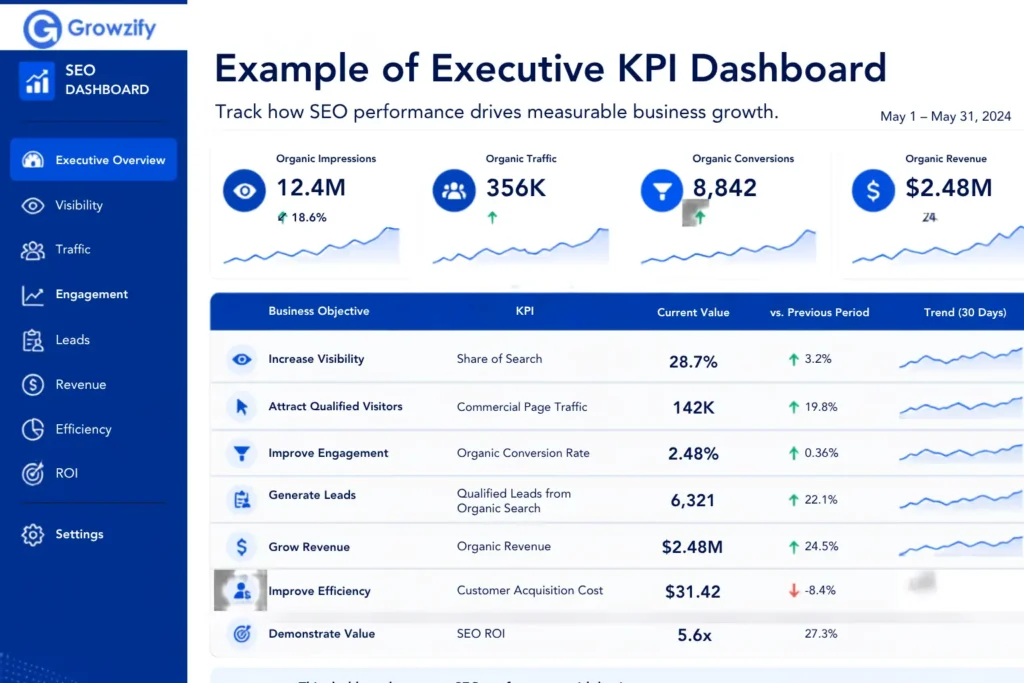
The most valuable enterprise SEO metrics are the ones that connect search visibility to measurable business outcomes. Rankings, impressions, and traffic remain important because they help identify opportunities and diagnose performance issues. However, qualified leads, pipeline, revenue, customer acquisition cost, and SEO ROI are the KPIs that demonstrate SEO’s true commercial value.
Measure Enterprise SEO Like a Growth Channel
Enterprise SEOis most effective when every metric serves a clear purpose. Rankings, impressions, clicks, and technical health remain valuable because they help explain how your website performs in search. However, their greatest value comes from showing how they influence qualified leads, conversions, pipeline, revenue, and customer acquisition.
The strongest enterprise SEO programs connect search visibility with measurable business outcomes. Rather than reporting isolated metrics, they show how SEO supports long-term growth across every stage of the customer journey.
Ultimately, the conversation should move beyond “How much traffic did SEO generate?” to “How much business growth did SEO help create?” When enterprise reporting answers that question, SEO becomes a strategic investment that executives can confidently measure, support, and scale.
AtGrowzify, we believe enterprise SEO should be measured by the business value it creates. By aligning technical performance, content strategy, and AI search visibility with meaningful business KPIs, organizations gain a clearer understanding of SEO’s contribution to growth.
Frequently Asked Questions About Enterprise SEO Metrics
What are the most important enterprise SEO metrics?
The most important enterprise SEO metrics include organic visibility, qualified traffic, conversion rate, qualified leads, pipeline contribution, revenue, customer acquisition cost (CAC), SEO ROI, and technical website health. Together, these KPIs measure both search performance and business impact.
Which SEO KPI is most important for revenue?
There is no universal single revenue KPI. Ecommerce teams may prioritize attributed revenue or gross profit; B2B organizations often rely on qualified pipeline and closed-won revenue; subscription businesses may also track ARR, CAC and LTV:CAC. The right primary KPI depends on the business model and sales cycle. Supporting metrics like qualified leads and conversion rate provide additional business context.
How do enterprises measure SEO ROI?
Enterprises measure SEO ROI by comparing the business value generated from organic search, such as leads, conversions, and revenue, against the total investment in SEO. This helps determine SEO’s overall contribution to business growth.
How do you measure SEO-generated pipeline?
SEO-generated pipeline is measured by tracking how organic visitors progress into qualified leads, sales opportunities, and customers. Connecting website analytics with CRM data helps attribute pipeline value and revenue to organic search.
Is organic traffic still an important SEO KPI?
Yes. Organic traffic remains an important SEO KPI because it measures your website’s ability to attract visitors through search. However, it should always be evaluated alongside conversions, qualified leads, and revenue to understand its true business impact.
Should enterprises track branded and non-branded traffic separately?
Yes.Tracking branded and non-branded traffic separately helps enterprises understand whether SEO is strengthening brand awareness or attracting new customers. Measuring both provides a clearer view of market reach, growth opportunities, and overall SEO performance.
How often should enterprise SEO KPIs be reviewed?
Enterprise SEO KPIs should be reviewed regularly, with the frequency depending on the metric. Monitoring performance consistently helps identify opportunities, address issues early, measure business impact, and ensure SEO efforts stay aligned with organizational goals.

Chitranshu SharmaA growth strategist, digital marketing consultant, and the founder of Growzify, a performance-driven agency helping brands dominate search, shape perception, and build sustainable online visibility. With 8+ years of hands-on experience in Enterprise SEO, Online Reputation Management (ORM), and AI-led traffic generation, Chitranshu has helped startups, public figures, SaaS companies, and cannabis brands outrank competitors — ethically and at scale.
Explore More Articles
How to Build a Technical SEO Monitoring Stack for Large Websites
How to Build a Technical SEO Monitoring Stack for Large Websites A technical SEO regression...
September 2, 2026Enterprise

Identifying and Fixing Thin Content Pages on Large Websites
Identifying and Fixing Thin Content Pages on Large Websites A page can be 2,000 words...
September 2, 2026Enterprise
How to Deploy and Maintain Structured Data and Rich Snippets Across a Website with Thousands of Pages
How to Deploy and Maintain Structured Data and Rich Snippets Across a Website with Thousands...
September 1, 2026Enterprise
Pre-Deployment Technical SEO Checklist for Large Enterprise Websites
Pre-Deployment Technical SEO Checklist for Large Enterprise Websites A single enterprise deployment can introduce a...
September 1, 2026Enterprise
How to Fix Core Web Vitals and Page Speed for an Enterprise Website
How to Fix Core Web Vitals and Page Speed for an Enterprise Website Enterprise Core...
August 31, 2026Enterprise
Robots.txt Best Practices for Complex, Large Enterprise Websites
Robots.txt Best Practices for Complex, Large Enterprise Websites A single overly broad robots.txt rule can...
August 27, 2026Enterprise

How to Structure XML Sitemaps for Large Websites
How to Structure XML Sitemaps for Large Websites A single sitemap file listing two million...
August 27, 2026Enterprise