



How to Deliver SEO Services Without an Internal Team
Discover how agencies deliver SEO services without an internal team by leveraging white label solutions, streamlined processes, and scalable systems for consistent growth.

Written byChitranshu Sharma
May 4, 2026
Quick Nav
You can deliver professional SEO services to clients without a single in-house SEO specialist on your payroll. Thousands of small agencies do it every month — through white label providers, freelancer networks, and hybrid delivery models that keep overhead low while delivering measurable organic results.
This is not about cutting corners. It is about building a delivery structure that matches how small agencies actually operate: lean teams, limited capital, and clients who need real results on a real timeline.
Here is exactly how to set it up, what it costs, how to manage quality, and what to tell your clients.
The Real Cost of Building an In-House SEO Team
Before exploring alternatives, it helps to understand what you are avoiding.
A single mid-level SEO specialist in the United States commands a median salary of $68,230 annually, according to the Bureau of Labor Statistics (2025). Add employer taxes, benefits, software tools (Ahrefs, Semrush, Screaming Frog, and reporting platforms run $500–$1,200/month combined), onboarding time of 60–90 days, and ongoing training costs, and the true cost of one in-house SEO hire exceeds $95,000 in year one.
That hire can realistically manage five to eight active SEO clients at a professional level. At an average retainer of $1,200/month, eight clients generate $9,600/month — barely enough margin to cover the hire after overhead.
The math only works when you have 15 or more SEO clients, enough fulfillment demand to justify the fixed cost. Most small agencies are nowhere near that threshold when they first add SEO to their service stack.
The outsourced model solves this directly.
Three Models for Delivering SEO Without In-House Staff
Model 1: White Label SEO Provider
Awhite label SEO providerhandles all fulfillment — technical audits, on-page optimization, content, link building, and reporting — under your agency’s brand. You manage the client relationship. They do the work.
Best for: Agencies with 3–25 SEO clients who want a predictable, hands-off fulfillment process.
Cost range: $300–$1,500/month per client at wholesale, depending on service scope.
Margin: Typical agency markup is 30–50%. A $600/month wholesale package commonly retails at $900–$1,000/month.
Model 2: Vetted SEO Freelancer Network
You build a roster of 2–4 specialist freelancers — one for technical SEO, one for content, one for link building — and coordinate delivery yourself using project management tools.
Best for: Agencies that want more control over deliverables and have a project manager (even part-time) who can coordinate across contractors.
Cost range: $40–$120/hour per specialist, or $800–$2,500/month per client in total freelancer costs depending on scope.
Margin: Higher potential margin, but higher management overhead. Works best when a process-driven account manager owns coordination.
Model 3: Hybrid Delivery
You use a white label provider for core monthly deliverables (audits, reporting, on-page work) and supplement with specialist freelancers for specific tasks — original research content, link outreach campaigns, or technical migrations.
Best for: Growing agencies with 10–30 clients who need flexibility without the complexity of managing a full freelancer network.
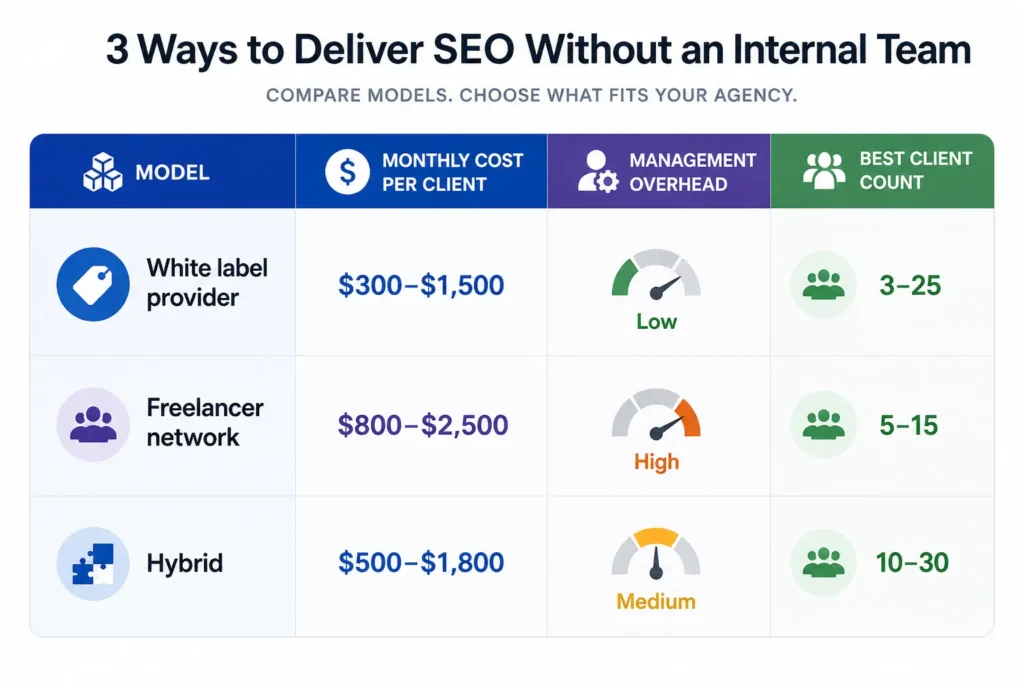
For most agencies reading this, Model 1 is the right starting point. You can evolve toward a hybrid model as volume grows and you identify the specific gaps a white label provider does not cover well.
How to Build Your SEO Delivery Stack in 5 Steps
Setting up a functional outsourced SEO operation takes two to four weeks if you move efficiently.
- Define your SEO service tier. Decide what your standard SEO retainer includes before sourcing a provider. Know whether you are targeting local businesses, e-commerce clients, or service-area companies — the fulfillment requirements differ significantly. Document this as a one-page scope template.
- Shortlist white label providers. Contact three to five candidates. Ask each for a sample deliverables package, an anonymized case study with organic traffic data, their link building methodology, and a sample monthly report. Evaluate the report quality closely — it will go to your clients under your name.
- Run a pilot on one client. Before committing your full client base to a provider, run a 90-day pilot on one client. Set internal benchmarks for deliverable turnaround time, report quality, and responsiveness. This gives you real data before scaling.
- Set up your project management layer. Use a tool like Asana, ClickUp, or Notion to track deliverable status, client notes, and QA checkpoints across accounts. Even with a reliable provider, you need visibility into what is happening on each client each month.
- Build your client reporting template. White label reports often need light customization — your logo, your color scheme, a brief commentary section where you add strategic context. Build this template once and use it across all accounts.
What to Tell Clients Without Revealing Your Setup
This question comes up in every agency that moves to outsourced delivery. The honest answer: you do not need to say anything specific, and most agencies do not.
What clients hire you for is results, accountability, and clear communication. They are not buying a specific person’s labor — they are buying outcomes. Your agency remains the strategic lead, the point of contact, the entity responsible for their results. That relationship does not change because fulfillment happens through a trusted partner.
If a client directly asks whether you use external help, the straightforward answer is:“Like most agencies, we have specialist partners we work with on specific deliverables — it means you get expert-level execution across every area of SEO rather than one generalist handling everything.”That is honest, reassuring, and accurate.
What you must never do is make explicit promises that contradict the setup — claiming you have a six-person in-house SEO team when you do not, for example. Transparency about your model, when asked, builds trust rather than undermining it.
How to Maintain Quality When You Are Not Doing the Work
Quality control is where outsourced SEO delivery succeeds or fails. Build these four checkpoints into your monthly process:
Deliverable review before client send. Never forward a white label report directly to a client without reading it yourself. Check that all promised deliverables are present, that rankings data is current, and that the narrative accurately reflects what happened that month.
Monthly link profile audit. Review the backlinks built each month using Ahrefs or Semrush. Look for links from irrelevant domains, link farms, or sites with spam scores above 30. One low-quality link building campaign can take 6–12 months to recover from — catching it early is far cheaper.
Quarterly strategy alignment call. Schedule a 30-minute call with your provider every 90 days. Review which accounts are performing below expectation, identify the likely cause, and agree on adjustments. Providers who resist these conversations are providers to replace.
Client check-in independent of the report. Send a brief personal email or make a short call to each SEO client monthly — separate from the formal report. Ask how the business is performing, whether their priorities have shifted, and whether they have questions. This conversation catches client dissatisfaction early and reinforces that you — not a PDF — are managing their account.
How to structure agency SEO reporting for client retention
Scaling from 5 to 30 SEO Clients Without Hiring
With a reliable white label provider in place, a single account manager can oversee 15–25 SEO clients — roughly three times the capacity of managing in-house delivery on the same headcount.
The scaling inflection points to watch:
- At 10 clients: Standardize your onboarding intake process. A consistent brief reduces provider back-and-forth and speeds up campaign launches.
- At 20 clients: Add a part-time account coordinator to handle report customization, QA checks, and client scheduling. This keeps your senior staff focused on strategy and sales.
- At 30+ clients: Evaluate whether a hybrid model makes sense. At this volume, a dedicated in-house SEO strategist who manages provider relationships (rather than doing fulfillment) starts generating positive ROI.
According to a 2024 report by HubSpot, agencies that offer SEO services retain clients for an average of 24 months — significantly longer than one-time project clients. Building a scalable delivery model early means the compounding revenue from that retention goes directly to margin, not headcount.
Agency pricing models: retainer vs. project vs. performance
Frequently Asked Questions
Can a small agency deliver SEO without in-house staff?
Yes. Most small agencies deliver SEO through white label providers, freelancer networks, or a hybrid of both. With a clear quality control process, clients receive consistent professional SEO regardless of who fulfills the work behind the scenes.
What is the cheapest way to deliver SEO services as an agency?
For agencies with fewer than ten active SEO clients,white label SEOfulfillment is typically the most cost-effective model. Wholesale packages start around $300–$500/month per client, compared to $55,000–$85,000/year for a single in-house SEO hire plus tools and benefits.
Do I need to tell clients I am outsourcing their SEO?
No legal obligation requires disclosure of your fulfillment model, and most agencies do not proactively mention it. Your clients are buying results and accountability — both of which remain with your agency. If asked directly, be honest about using specialist partners without misrepresenting your structure.
How do I maintain quality control when outsourcing SEO?
Review every report before it reaches the client. Audit the backlinks built each month. Hold quarterly alignment calls with your provider. And maintain a direct monthly touchpoint with each client that is separate from the formal report. These four habits catch problems before clients notice them.
How many SEO clients can one account manager handle when outsourcing?
With reliable white label fulfillment in place, one account manager can comfortably oversee 15–25 SEO clients — compared to five to eight when managing in-house delivery. That capacity difference is the core financial argument for the outsourced model.
Build the SEO Offer. Skip the Overhead
Delivering great SEO does not require a team of specialists on your payroll. It requires a clear delivery model, a reliable fulfillment partner, tight quality control, and consistent client communication. Agencies that build this infrastructure early grow their recurring revenue while keeping the lean structure that makes small agencies fast and profitable.
The first step is straightforward: define your SEO service scope, shortlist three white label providers, and run a 90-day pilot before committing. Most agencies that do this are onboarding their second and third SEO client within 60 days.
Talk to us about adding SEO to your agency stack.
Want to add SEO revenue without adding headcount?Let’s talk →

Chitranshu SharmaA growth strategist, digital marketing consultant, and the founder of Growzify, a performance-driven agency helping brands dominate search, shape perception, and build sustainable online visibility. With 8+ years of hands-on experience in Enterprise SEO, Online Reputation Management (ORM), and AI-led traffic generation, Chitranshu has helped startups, public figures, SaaS companies, and cannabis brands outrank competitors — ethically and at scale.
Explore More Articles
How to Find and Compare Local SEO Outsourcing Providers
How to Find and Compare Local SEO Outsourcing Providers Finding a local SEO outsourcing provider...
October 13, 2026Outsourcing

Inside a White Label SEO Campaign: How the Work Gets Done
Inside a White Label SEO Campaign: How the Work Gets Done Clients see a single...
October 13, 2026White Label

How to Vet an SEO Outsourcing Provider Before You Sign a Contract
How to Vet an SEO Outsourcing Provider Before You Sign a Contract A polished proposal...
October 9, 2026Outsourcing

Multilingual SEO Best Practices: Optimize Your Multi-Language Website
Multilingual SEO Best Practices: Optimize Your Multi-Language Website Translating a page and localizing it for...
October 7, 2026SEO

What Makes In-House Enterprise SEO Work Different Day-to-Day?
What Makes In-House Enterprise SEO Work Different Day-to-Day? On a small site, deciding to fix...
October 7, 2026Enterprise

How Core Algorithm Updates Impact Large Sites Differently Than Small Ones
How Core Algorithm Updates Impact Large Sites Differently Than Small Ones A large enterprise site...
October 7, 2026Enterprise
When Should You Outsource SEO? 11 Signs It Makes Sense
When Should You Outsource SEO? 11 Signs It Makes Sense Outsourcing SEO does not necessarily...
September 26, 2026Outsourcing