



White Label SEO vs Freelancers vs Offshore Teams: How it Scales
Scaling an SEO agency requires the right execution model. This guide compares white label SEO, freelancers, and offshore teams breaking down cost, control, scalability, and long-term growth potential to help you choose the best solution for sustainable expansion.

Written byChitranshu Sharma
February 26, 2026
Quick Nav
In 2025, agencies and founders face increasing pressure when deciding how to scale SEO operations. Algorithm updates, rising content demands, tight timelines, and payroll risks have pushed many agencies to rethink traditional hiring models. Instead of expanding internal teams, many delegate core SEO tasks strategically to white label teams.
When managing client expectations, execution speed and communication clarity become critical. Delays, misalignment, or inconsistent quality can directly impact client retention. This raises an important question: should you hire freelancers, build an offshore team, or partner with awhite label SEO provider?
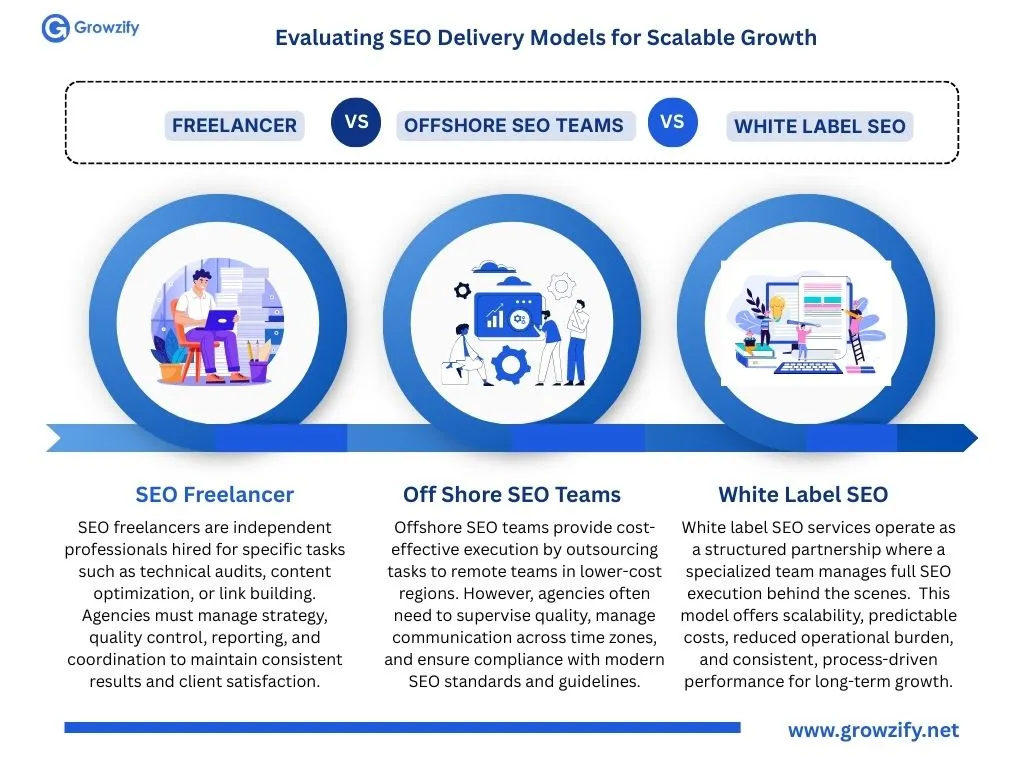
Each model offers different advantages in terms of scalability, cost efficiency, turnaround time, quality control, and operational stability. The key is understanding how each works and which structure aligns best with your business goals, growth stage, and delivery expectations.
Most agencies today evaluate three primary options: White Label SEO partners, independent SEO freelancers, or offshore SEO teams. While each serves a purpose, they differ significantly in reliability, transparency, accountability, and long-term scalability.
In the following section, we break down how these three SEO delivery models operate, their advantages, limitations, and which option best supports your roadmap for sustainable growth.
Understanding the Three Core SEO Outsourcing Models
As agencies grow and client demands increase, choosing the right SEO outsourcing model for your business needs becomes a strategic decision. That directly impacts scalability, profitability, delivery quality, and long-term operational stability. Let’s understand how the White Label SEO, SEO freelance, and Offshore SEO work best.
Partnership Model: White Label SEO for Agencies
White Label SEO is a strategic partnership modelin which a specialized SEO provider manages SEO execution behind the scenes. While your agency delivers the services under its own brand name.
This model allows agencies to scale efficiently without expanding internal teams. Most agencies expect a white label SEO partner to provide reliability, consistent quality, and scalable processes. With measurable performance outcomes that align with client goals and long-term growth strategies.
A professional white label SEO provider follows ethical, Google-compliant processes to manage strategy, technical optimization, content, andWhite Label link building. Ensuring sustainable rankings and long-term growth. All deliverables and performance reports are provided in fully white-labeled formats, allowing you to maintain brand ownership and client trust.
White label SEO is built on strategic planning, precise execution, and measurable results. Delivering consistent performance and long-term growth. Here’show it works.
How the White Label SEO Model Works
White label SEO focuses on data-driven strategy, precise execution, and result-oriented performance. Enabling agencies to scale confidently while delivering impactful SEO outcomes under their own name.
- Step 1: Partnership and NDA Agreement:Your agency partners with a white label SEO provider and establishes confidentiality through an NDA and a defined service scope.
- Step 2: Partner Onboarding:You share project details, access credentials (GSC, GA4, CMS, etc.), and campaign objectives with the white label SEO team.
- Step 3: Audit & Strategy Development:White label SEO team conducts a comprehensive SEO audit, competitor analysis, and keyword research. To create a data-driven strategy aligned with client goals.
- Step 4: Execution & Optimization:Technical SEO, on-page optimization, content implementation, link building, and performance improvements are executed systematically behind the scenes.
- Step 5: White-Labeled Reporting:Detailed performance white-labeled reports are prepared under your agency’s branding, highlighting rankings, traffic growth, and completed deliverables.
- Step 6: Ongoing Optimization & Scaling:The campaign is continuously monitored, refined, and scaled to improve performance, retain clients, and support long-term growth.
The white label SEO partner acts as an extension of your team, following defined processes, performance metrics, and transparent reporting systems.
Why Agencies Prefer This Model
- Immediate access to experienced SEO professionals
- No hiring, training, or HR management
- Scalable infrastructure
- Predictable costs
- Reduced operational burden
This model is built specifically for agencies that want to grow without increasing internal overhead. By understanding how each model operates and evaluating them against your growth goals, resource capacity, and client expectations. You can choose a structure that supports sustainable expansion and consistent SEO performance.
Independent Model: SEO Freelancers
The independent SEO freelancer model offers agencies flexible, task-based support. By outsourcing specific SEO activities to individual professionals rather than partnering with a structured team. Freelancers are individual SEO professionals hired per task or on a monthly retainer. They may specialize in areas such as technical SEO, content optimization, or link building.
How the SEO Frelancer Model Works
The independent SEO freelancer model offers agencies flexible, task-based support. By outsourcing specific SEO activities to individual professionals rather than partnering with a structured team.
- Step 1: Identify the SEO Need:The agency defines specific SEO tasks, such as technical fixes, content optimization, keyword research, or link building, that require external support.
- Step 2: Hire the Freelancer:You search, evaluate, and onboard an SEO freelancer based on experience, specialization, pricing, and availability.
- Step 3: Define Scope & Deliverables:The agency outlines clear instructions, timelines, KPIs, and expected outcomes. To ensure alignment and reduce misunderstandings.
- Step 4: Task-Based Execution:The freelancer executes assigned SEO activities independently, such as optimizing pages, conducting audits, or creating content.
- Step 5: Review & Quality Control:The agency reviews completed work and ensures quality standards are met. It integrates deliverables into the overall SEO strategy.
- Step 6: Client Reporting & Communication:The agency prepares reports, communicates updates to clients, and manages strategy adjustments while coordinating with the freelancer as needed.
While this model provides flexibility and lower upfront costs. In this model, the agencies must actively manage strategy, quality control, and client communication to ensure consistent results and long-term performance.
Freelancers operate independently. You are responsible for project management, quality control, and overall SEO direction.
When This Model Works
- Best for growing agencies that need scalable SEO without hiring internally.
- Ideal for agencies lacking in-house SEO expertise or infrastructure.
- Suitable for businesses focused on sales, strategy, and client relationships.
- Perfect for agencies seeking cost-efficient, reliable, and brand-controlled SEO delivery.
Where It Fits
- Small agencies with limited clients
- Short-term SEO needs
- Budget-sensitive projects
However, scalability becomes challenging as client volume grows. Availability, communication, and consistency depend entirely on one individual.
Cost-Efficient Model: Offshore SEO Teams
Offshore SEO teams are typically hired to reduce expenses. They often operate as execution-focused teams rather than strategic partners.
How the Offshore SEO Team Works
The offshore SEO team model focuses on outsourcing SEO execution to teams located in regions, primarily to reduce operational expenses and handle large volumes of work.
- Step 1: Define Project Scope:The agency outlines the agreement and then outlines SEO requirements, deliverables, timelines, and KPIs before assigning tasks to the offshore team.
- Step 2: Team Onboarding & Access:Necessary access to tools and platforms (GSC, GA4, CMS, etc.) is shared, and communication channels are established.
- Step 3: Task Assignment:Specific tasks such as link building, keyword research, content drafting, or audits are delegated to the offshore team.
- Step 4: Execution & Implementation:The offshore team executes assigned SEO tasks based on instructions and predefined processes.
- Step 5: Supervision & Quality Review:The agency reviews completed work, checks for quality and compliance, and ensures alignment with client expectations.
- Step 6: Reporting & Client Communication:The agency compiles results into client-facing reports and manages strategy discussions while coordinating feedback with the offshore team.
While offshore SEO teams can offer cost advantages and execution capacity. Is good for the agencies to invest time in supervision, quality control, and communication to maintain consistent performance and protect client trust.
When This Model Works
- You assign bulk SEO tasks (links, content, audits).
- The offshore team executes based on instructions.
- You oversee strategy and quality.
- Communication often happens across time zones.
This model emphasizes cost reduction but requires strong supervision and internal management.
Where It Fits
- Agencies focused primarily on lowering costs
- Task-based execution support
- High-volume repetitive SEO work
However, communication gaps, quality inconsistencies, and outdated SEO practices can create risks if not closely monitored.
Choosing the right SEO outsourcing model directly influences your scalability, operational efficiency, and long-term profitability. Each structure offers distinct advantages. Basically, the ideal choice depends on your growth stage, resources, and strategic priorities. Evaluate carefully to ensure your decision supports sustainable performance, client satisfaction, and consistent business expansion.
How to Evaluate an Ideal SEO Model for Your Business
Selecting the right SEO model is a strategic decision for an agency or business. It has a direct impact on your scalability, profitability, operational efficiency, and long-term business growth. Let’s understand the ideal criteria a business needs to evaluate the SEO model.
Assess Your Growth Stage
Determine whether your business is in early development or rapid expansion. A scalable SEO model is essential if you plan to onboard multiple clients. You need to understand the nature of your business and assess the business model.
Evaluate Internal Resources
Consider what your business performs, whether you havein-house expertise, time, and management capacity. What your business requires to handle strategy, execution, reporting, and performance tracking effectively.
Compare Cost vs Long-Term Value
Look beyond initial pricing. Factor in hiring costs, training, management time, tool subscriptions, and potential inefficiencies that impact overall ROI. All these costing factors are essential to ensure that the model goes well with your agency’s requirements.
Review Quality Standards & Compliance
Ensure the SEO model follows ethical, Google-compliant practices. Sustainable SEO protects your brand reputation and delivers long-term ranking stability.
Examine Communication & Transparency
Clear reporting, defined KPIs, structured workflows, and consistent updates are essential for maintaining accountability and building client trust. These factors drive measurable performance improvements, strengthen transparency, and directly contribute to sustainable business growth and improved results.
Measure Scalability & Flexibility
The right SEO model should scale alongside your business without creating operational disruptions or increasing risk. This is a critical factor to consider when choosing between freelancers, offshore teams, or a white label SEO partner, as each model impacts stability, scalability, and long-term growth differently.
Consider Risk & Dependency Factors
Evaluate potential risks such as employee turnover, freelancer availability, or quality inconsistencies that may affect delivery. These factors need attention before you decide on the business model that works well for accomplishing clients’ projects.
Align With Business Objectives
Choose an SEO model structure that supports your long-term goals, whether that’s cost efficiency, scalability, brand control, or predictable growth.
By carefully evaluating your goals, resources, and growth plans, you can choose an SEO model that delivers consistent results, protects your brand reputation, and supports sustainable expansion.
Aligning Your SEO Model with Business Expansion
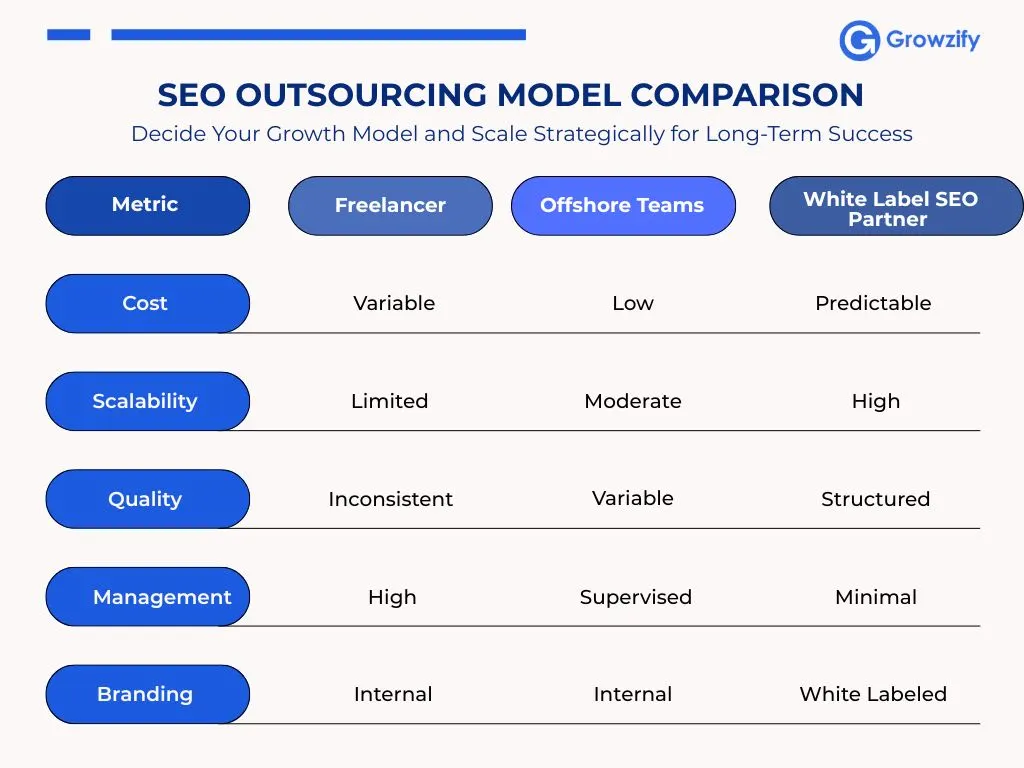
This comparison highlights that the right SEO model is not just about cost, but about scalability, consistency, operational control, and long-term growth. What truly matters is choosing a structure that aligns with your business expansion plans, resource capacity, and client expectations. Thus, ensuring sustainable performance, predictable delivery, and strategic growth over time.
Scalable success begins with the right foundation; make your SEO model your growth advantage.
To grow your business effectively, analyze which SEO model works best: transactional outsourcing or a long-term, scalable growth engine.
FAQs
Is white label SEO better than hiring freelancers?
For scaling agencies, yes. It offers structured systems, reliability, and consistent reporting without internal management burden.
Are offshore SEO teams reliable?
They can be cost-effective, but require strong supervision to maintain quality and compliance with modern search guidelines.
Which SEO outsourcing model is most scalable?
White label SEO is the most scalable because it provides infrastructure, expertise, and process-driven delivery.

Chitranshu SharmaA growth strategist, digital marketing consultant, and the founder of Growzify, a performance-driven agency helping brands dominate search, shape perception, and build sustainable online visibility. With 8+ years of hands-on experience in Enterprise SEO, Online Reputation Management (ORM), and AI-led traffic generation, Chitranshu has helped startups, public figures, SaaS companies, and cannabis brands outrank competitors — ethically and at scale.
Explore More Articles

How White Label SEO Helps Agencies Scale Without Hiring
How White Label SEO Helps Agencies Scale Without Hiring White label SEO allows agencies to...
January 28, 2026White Label

White Label SEO working Behind scenes
What Is White Label SEO? How It Actually Works Behind the Scenes White label SEO...
January 27, 2026White Label

White Label SEO vs In House SEO
White Label SEO vs In-House SEO: Which Path Leads to Growth? As SEO demand continues...
January 21, 2026White Label

E-commerce SEO Strategy: 7 Tips That Drive Sales & Revenue
E-commerce SEO Strategy: 7 Tips That Drive Sales & Revenue An effective e-commerce SEO strategy...
January 14, 2026Ecommerce

How to Choose the Best White Label SEO Agency in India
How to Choose the Best White Label SEO Agency in India Choosing the right white...
January 7, 2026White Label
🔍
Why SEO Matters for Manufacturing Companies
Why SEO Matters for Manufacturing Companies Strong online visibility helps manufacturers reach decision-makers, generate qualified...
September 10, 2025Manufacturing
🔍
What is SEO in the Pharmaceutical Industry?
What is SEO in the Pharmaceutical Industry? In a highly regulated and competitive field, strategic...
September 9, 2025Pharma