


E-commerce SEO Strategy: 7 Tips That Drive Sales & Revenue
An effective e-commerce SEO strategy helps online stores increase visibility, attract high-intent shoppers, and convert traffic into revenue. This guide covers 7 proven SEO tips to improve rankings, product discovery, and sales performance.

Written byChitranshu Sharma
January 14, 2026
Quick Nav
The e-commerce industry is expanding rapidly, and competition is increasing just as fast. With more brands moving online, e-commerce businesses are focused on attracting the right buyers and turning traffic into consistent sales.
Think about the last time you searched for a product online, “best winter jackets” or “handloom stores near me.” You likely clicked on one of the top results and decided within minutes. This is how e-commerce SEO works in real-world practice, by aligning search intent, visibility, and user experience to drive real sales and revenue.
The goal of an e-commerce SEO strategy is to make the right product or category page appear at the exact moment a buyer is ready to act.
In today’s market, having an offline store or a basic website is no longer enough. What matters is a strong online presence that builds trust, ensures visibility, and helps customers discover and choose your products easily. This is where e-commerce SEO connects user search behaviour with sustainable business growth.
This article explains how a structurede-commerce SEO strategysupports business goals and long-term growth. And attracts high-quality traffic, builds credibility, and turns searches into sales.
What Is E-commerce SEO?
E-commerce SEO is the ongoing process of optimising an online store to improve search visibility, attract high-intent buyers, and increase sales through organic search. Unlike general SEO, e-commerce SEO focuses:
- Category and product pages
- Buyer-driven keywords
- Technical performance
- Internal linking that supports conversions
It combines technical optimisation, on-page SEO, content, and link building. To enable search engines to understand what your business offers while guiding users smoothly toward purchase decisions. Once the search engine reads your website effectively, you can get ranked for the keywords and appear on thesearch engine result pages (SERP).
When executed correctly, e-commerce SEO becomes a scalable system for long-term growth and revenue.
How an E-commerce SEO Strategy Is Executed
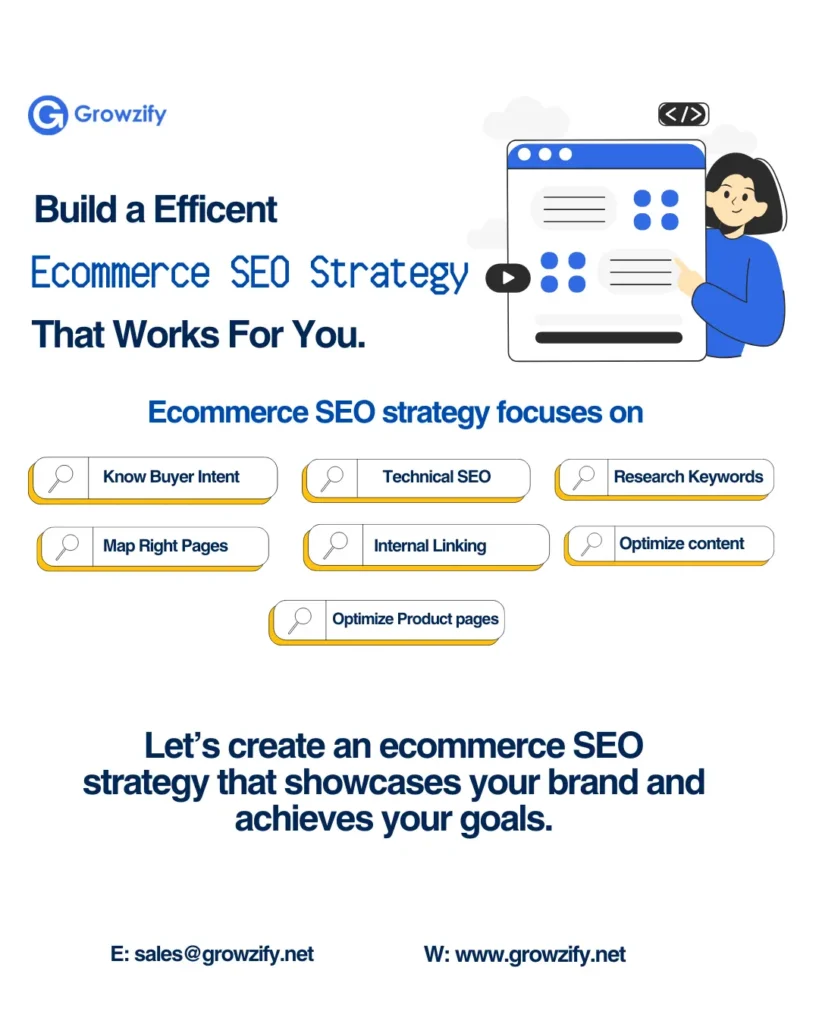
A successful e-commerce SEO strategy follows a structured, step-by-step approach rather than isolated actions. Core execution steps include:
Step 1: Market & keyword research
Identify high-intent search terms buyers actually use, including product, category, and price-based queries.
Step 2: Site architecture optimisation
Structure categories and product pages for clear navigation, crawlability, and user experience.
Step 3: On-page SEO
Optimise titles, descriptions, images, and page content for relevance and conversions.
Step 4: Technical SEO
Improve page speed, mobile responsiveness, indexing, and Core Web Vitals.
Step 5: Content creation
Develop SEO-optimised content that supports buying decisions and product discovery.
Step 6: Link building
Earn relevant, authoritative backlinks to strengthen domain and page authority.
Step 7: Performance tracking
Measure rankings, traffic quality, engagement, conversions, and revenue impact.
This structured execution of the e-commerce SEO strategy ensures SEO efforts translate into measurable business results.
7 Tips to Build an E-commerce SEO Strategy for Sales
A strong e-commerce SEO strategy focuses on buyer intent, visibility, and conversions. These seven practical tips show how to attract high-intent traffic and turn organic searches into consistent sales.
1. Understand How Buyers Actually Search Online
Every effective e-commerce SEO strategy starts with buyer behaviour. Customers search for products in different ways depending on intent. Common patterns include:
- Use case or need
- Budget or price range
- Trends and inspiration
- Comparisons
- Brand-specific searches
Examples:
- “Best winter outfit trends” (inspiration-based)
- “Winter jackets under ₹5,000” (price-driven)
When SEO reflects real buyer behaviour, traffic becomes more relevant, and conversions follow naturally. This alignment turns visibility into measurable sales.
2. Conduct Keyword Research Based on Purchase Intent
High search volume does not guarantee revenue; buyer intent does. An effective e-commerce SEO strategy uses different keyword types across the buying journey:
- Informational:research and learning
- Commercial:comparison before purchase
- Transactional:ready to buy
- Branded:brand-specific searches
- Local:location-based intent
Examples:
- Informational: “How to choose running shoes”
- Commercial: “Best running shoes for men”
- Transactional: “Buy running shoes online”
Intent-based keyword research attracts visitors who are closer to purchasing.
3. Map Keywords to the Right Pages for Conversions
One of the most common e-commerce SEO mistakes is sending traffic to the wrong page type. Correct keyword-to-page mapping looks like this:
- Broad commercial keywords to the category page.
- Specific product queries to the product page.
- Comparison searches to blogs or commercial content
Examples:
- “Winter jackets under ₹5,000” to the category page
- “Nike Air Zoom Pegasus price” to the product page.
- “Wireless earbuds vs neckband” to comparison blog
Proper mapping improves rankings, user experience, and conversions.
4. Build Category Pages That Drive Sales
Category pages often generate more revenue than blog content. To optimise category pages effectively:
- Add a 200–400-word keyword-focused introduction
- Use clear headings and subheadings
- Include FAQs to reduce hesitation
- Keep filter URLs clean
- Internally link to top-selling products
Well-optimised category pages attract high-intent traffic and convert faster than paid ads.
5. Optimise Product Pages for Rankings and Conversions
Product pages are where SEO turns into revenue.A strong product page includes:
- Unique, benefit-driven descriptions
- Reviews and ratings for trust
- FAQs to address objections
- Size or usage guides
- Fast loading speed and mobile optimisation
Example optimisation:
- Product: Men’s Black Cotton T-Shirt
- SEO title: “Men’s Black Cotton T-Shirt | Soft & Breathable”
- Usage copy: “Ideal for daily wear and casual outings”
- FAQs: “Is it shrink-resistant?” “Is it machine washable?”
Optimised product pages improve trust and conversion rates.
6. Fix Technical SEO Issues Before Scaling Content
Technical SEOis the foundation of e-commerce growth. Common issues include:
- Duplicate URLs from size or colour variations
- Slow page speed
- Broken links from discontinued products
- Indexing errors
Fixing technical SEO first ensures that every future SEO effort performs better and delivers results faster.
7. Use Internal Linking to Guide Customers to Buy
Internal linking shortens the buyer journey by guiding visitors smoothly from discovery to the right product pages. Helping them reach checkout faster with fewer decision barriers. The natural path looks like:
Blog – Category – Product – Related Products
Example:
- Blog: “How to Choose the Right Running Shoes”
- Link to: “Best Running Shoes for Beginners” category
- Link to size guide and related accessories
Effective internal linking reduces friction, increases engagement, and helps users reach checkout with confidence.
Quick FAQs
How long does e-commerce SEO take to show results?
E-commerce SEO typically shows results within 3–6 months, depending on competition, site structure, and consistency of optimisation.
Which pages should be optimised first?
Start with high-value categories and product pages that directly impact revenue.
Is e-commerce SEO better than paid ads long-term?
Yes. Paid ads stop when spending stops, while SEO compounds over time.
Why are category pages important?
They target high-intent keywords, capture more traffic, and guide buyers toward relevant products.
Key Takeaways: Grow Smarter With E-commerce SEO
Rather than chasing rankings, e-commerce SEO focuses on building a system that attracts high-intent buyers consistently. A successful strategy focuses on the areas that directly impact revenue rather than vanity traffic. Key focus areas are:
- By optimising category and product pages, this way e-commerce brands capture high-intent buyers at the point of decision. Thus, driving higher conversions and revenue.
- Building a strong technical SEO foundation for speed, crawlability, and reliability.
- Using internal linking and buyer-focused content to guide users toward checkout.
When these elements work together, your store becomes easier to find, easier to trust, and easier to buy from. A strategic ecommerce SEO strategy alignssearch intent,user experience, and technical foundations to deliver measurable, long-term business growth. A strong ecommerce SEO strategy turns search visibility into reliable, long-term revenue.

Chitranshu SharmaA growth strategist, digital marketing consultant, and the founder of Growzify, a performance-driven agency helping brands dominate search, shape perception, and build sustainable online visibility. With 8+ years of hands-on experience in Enterprise SEO, Online Reputation Management (ORM), and AI-led traffic generation, Chitranshu has helped startups, public figures, SaaS companies, and cannabis brands outrank competitors — ethically and at scale.
Explore More Articles
White Label Link Building: Is It Safe & Effective?
Is White Label Link Building an SEO-Safe Strategy? White label link building can be an...
February 3, 2026White Label

How White Label SEO Helps Agencies Scale Without Hiring
How White Label SEO Helps Agencies Scale Without Hiring White label SEO allows agencies to...
January 28, 2026White Label
White Label SEO working Behind scenes
What Is White Label SEO? How It Actually Works Behind the Scenes White label SEO...
January 27, 2026White Label

White Label SEO vs In House SEO
White Label SEO vs In-House SEO: Which Path Leads to Growth? As SEO demand continues...
January 21, 2026White Label
How to Choose the Best White Label SEO Agency in India
How to Choose the Best White Label SEO Agency in India Choosing the right white...
January 7, 2026White Label
🔍
Why SEO Matters for Manufacturing Companies
Why SEO Matters for Manufacturing Companies Strong online visibility helps manufacturers reach decision-makers, generate qualified...
September 10, 2025Manufacturing
🔍
What is SEO in the Pharmaceutical Industry?
What is SEO in the Pharmaceutical Industry? In a highly regulated and competitive field, strategic...
September 9, 2025Pharma