How to Vet an SEO Outsourcing Provider Before You Sign a Contract
How to Vet an SEO Outsourcing Provider Before You Sign...
Read More →
Translating a page and localizing it for search are two different jobs. A translated page can be linguistically correct and still miss the terminology, intent, and market context people actually search for in that language.

Multilingual SEO means creating separate, crawlable URLs for each intended language, researching terminology and search intent natively in that language, and localizing content where market context genuinely differs, rather than shipping a translated copy of one master page. Translation is only one production step; search localization is what determines whether the page actually fits how people search in that locale.
Methodology:This guide is grounded in Google Search Central’s own documentation on managing multi-regional and multilingual sites and on localized content versions, alongside recurring patterns observed inGrowzify enterprise SEOreviews. Statements attributed to Growzify are practitioner observations, not confirmed Google ranking mechanisms, and the composite example later in this article is illustrative rather than a client case study.
This distinction is worth establishing before anything else, since the rest of this guide depends on it.Google’s own documentationdefines the two directly: “a multilingual website is any website that offers content in more than one language,” while “a multi-regional website is one that explicitly targets users in different countries.”
A site can be multilingual without being region-specific, region-specific without using multiple languages, or both at once, and each combination changes what URL structure, hreflang, keyword research, pricing, product availability, legal content, and localization depth actually need to solve for.
A .de domain targets Germany, a country; it isn’t a universal signal for every German-speaking user regardless of where they are. An /en-us/ and /en-gb/ pair targets the same language aimed at two different countries, with potentially different spelling, currency, and regulatory content.
A /fr/ and /es/ pair on a single global domain, with no country-specific targeting at all, is a language decision without a regional one. Treating all of these as one problem is where a lot of multilingual SEO planning goes wrong before it starts.

A major multilingual SEO risk appears before the technical implementation even begins: treating translation and localization as the same task, and assuming that once a page is translated, the SEO work is basically done.
They aren’t the same task. A translated page carries over the source language’s sentence structure, keyword choices, and content priorities, even when every word is technically correct. A localized page is built for how people actually search and read in that language, which can mean different keywords, different content emphasis, and sometimes a genuinely different structure entirely. Translation answers what the source content means; localization answers what the target audience actually searches for and needs.
Getting the technical layer right, hreflang, URL structure, Search Console setup, matters, and Growzify’s guide ongeotargeting and international Search Console setupcovers that implementation in depth. This guide focuses on the content, architecture, and governance decisions that determine whether that technical layer has anything genuinely good to point search engines toward in the first place.
Because language and region are separate variables, the same language can need different treatment in different markets. This is worth mapping explicitly rather than assumed away.
| Version | Language | Market | What typically needs to differ |
| en-US | English | United States | US terminology, USD pricing, US-specific proof points |
| en-GB | English | United Kingdom | British spelling, GBP pricing, UK-specific regulation |
| fr-FR | French | France | French query research, France-specific context |
| fr-CA | French | Canada | Canadian French terminology, local context distinct from France |
Two markets sharing a language still need independent keyword research, independent regulatory review, and independent content decisions where local context differs, since the language being the same doesn’t mean the market is.
Google’s own documentation lays out three structural options forinternational URL structure, and each comes with real tradeoffs rather than one obviously correct answer.
A country-code top-level domain such as .de provides a strong country-targeting signal for Germany and makes server location irrelevant to that signal, but it’s expensive to acquire and maintain across many markets, requires operating and promoting each country site as its own distinct web property, and should be understood as country targeting, not a universal language-targeting mechanism for every German-speaking user regardless of location. Subdomains and subdirectories on a single generic domain are both easier and cheaper to set up and maintain, though Google’s own guidance notes users may not recognize the geotargeting from the URL alone the way they would with a ccTLD.
For organizations without a strong reason to fragment across country domains, Growzify generally treats a subdirectory structure, /de/, /fr/, /es/, as a practical starting option: comparatively simple to operate and maintain within a single domain’s infrastructure, and still fully compatible with hreflang and Google’s other locale-targeting signals.
The right choice ultimately depends on whether the business needs language separation, country separation, infrastructure independence, or some combination of all three, not a single universal best answer.
Google’s own guidance is explicit that translating only a page’s boilerplate, navigation, headers, footers, while leaving the actual content in a single source language, creates a bad experience: the same underlying content effectively appears multiple times in search results, just wrapped in different-language furniture.
This tends to happen under deadline pressure: a new market launches with the navigation and legal pages translated, but the actual product or content pages ship untranslated, with a plan to “translate properly later” that often doesn’t happen on schedule. The page technically exists in the new locale, but it fails to provide the genuinely localized experience that language version is supposed to serve.
One technical detail worth knowing: Google’s documentation states it uses “the visible content of your page to determine its language,” explicitly not “code-level language information such as lang attributes, or the URL.” The HTML lang attribute still matters for accessibility and browser behavior, but it doesn’t substitute for genuinely translated visible content, and a page relying on it while leaving the body text in the source language won’t read as localized to Google either.
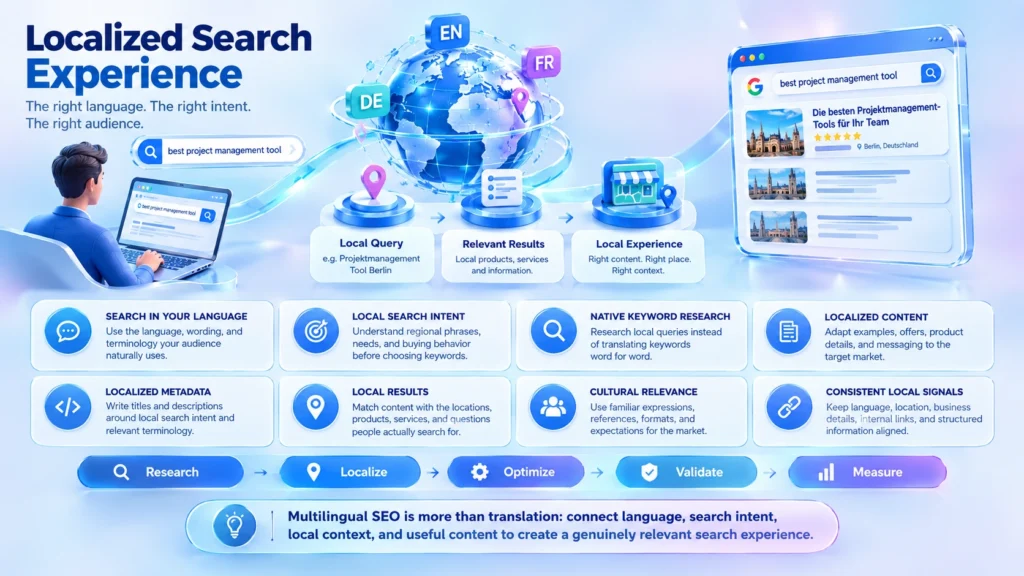
A tempting shortcut, IP-based automatic redirection to a single “correct” language version, is one Google’s own documentation specifically warns against, stating directly: “Don’t use IP analysis to adapt your content. IP location analysis is difficult and generally not reliable. Furthermore, Google may not be able to crawl variations of your site properly.”
The practical consequence is worth taking seriously: forced locale redirects can make some language or regional versions harder for Google to consistently crawl and discover, since a crawler in one region can get redirected before it ever sees the version meant for a different one.
Using location detection to suggest a version, a dismissible banner offering to switch, is a meaningfully different thing from using it to forcibly reroute the URL. A visible language selector, with the ability to switch freely and a sensible default rather than a forced redirect, avoids the crawlability problem while still guiding most users to the right version most of the time.
The content and strategy decisions above are what actually make a language version worth ranking; the technical layer is what helps Google understand the relationships between versions and select an appropriate localized result, not a guarantee of which URL gets shown. Growzify’s guide ongeo targeting and internationalSearch Console setupcovers each of these in full implementation detail; this is the condensed version worth checking against any multilingual site.
Hreflang itself can be implemented through HTML link elements, an HTTP header, or an XML sitemap; Google treats the three as equivalent, so the right choice is whichever is easiest to maintain reliably at the site’s scale. Sitemap-based hreflang in particular tends to be easier to manage on very large sites than annotating each page’s HTML individually.
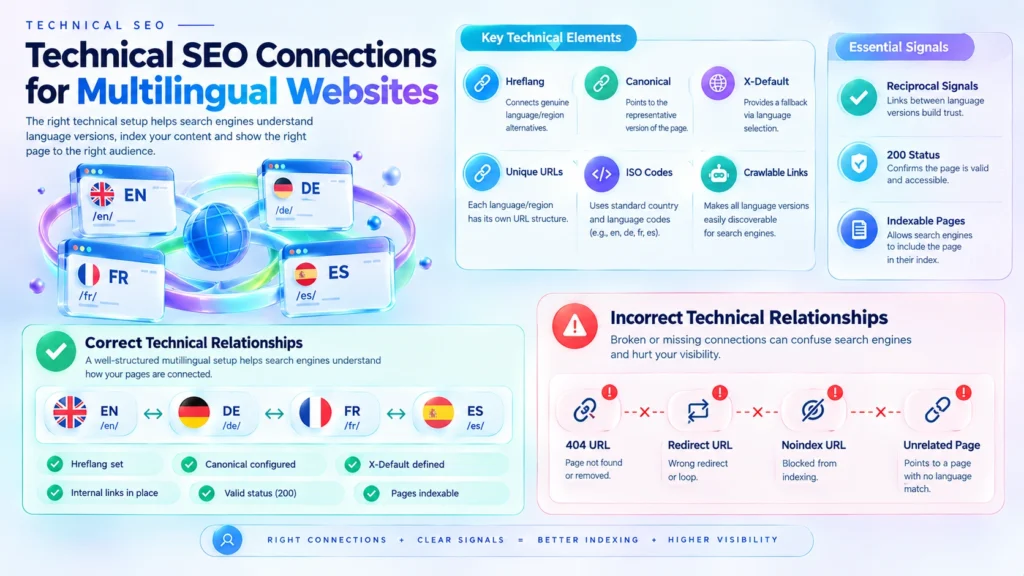
These two get conflated constantly, and the confusion causes real mistakes. Hreflang identifies alternate URLs intended for different languages or regions; it’s a signal about which version fits which audience. Canonicalization identifies which URL among duplicate or substantially similar URLs should be treated as the representative one; it’s a signal about which URL to actually index and rank.
Genuine translated pages normally shouldn’t be collapsed back to the source-language URL through a cross-language canonical tag just because they cover the same topic, since they’re different content serving different audiences, not duplicates of each other.
Same-language regional duplicates are a different case: where two country versions in the same language carry substantially identical content, Google’s own guidance recommends picking a preferred version and using canonical and hreflang together to serve the right one.
It’s also worth remembering that a declared canonical is a hint, not a command; Google can select a different URL than the one specified, which matters more on international sites since content similarity across regional versions in the same language increases the chance of that happening.
A site running en-US, en-GB, and en-AU versions with genuinely different content, different spelling conventions, different currency, different regulatory detail, treats each as its own indexable page with reciprocal hreflang connecting them. Where those versions are substantially identical in practice, that’s the specific case Google’s own guidance addresses with a combined canonical-plus-hreflang approach: pick the preferred version, canonicalize the duplicates to it, and let hreflang still route the right regional audience to whichever version is actually meant to serve them.
Where a provider can make live technical changes, it’s worth clarifying upfront who approves those changes and whether staging, backups, or a rollback plan are required before anything ships to production, and confirming an implementer and a validation step so a change isn’t recorded as done simply because it was sent somewhere. A workstream is genuinely ready to start once the provider has the access, context, authority, and any dependency it needs, not before.
If the business handing off SEO is itself an agency reselling the work to its own clients, this ownership question gets a layer more complex, since someone still needs to review deliverables before they reach the end client. Growzify’swhite label SEO servicesare built specifically for that structure, where an agency keeps the client relationship, and Growzify handles execution behind the scenes.
This is a practitioner framework Growzify uses to evaluate how genuinely localized a language version actually is, not a Google-documented scoring system. It ranks four tiers, from weakest to strongest.
| Tier | What it involves | What this improves |
| Machine translation only | Automated translation, no human review | Fast coverage, but frequently unnatural phrasing and a higher quality-review burden |
| Human-reviewed translation | A native speaker corrects and smooths a machine or literal translation | Language quality and accuracy, though still structured around the source language’s content priorities |
| Locale-specific keyword optimization | Content restructured around actual search behavior in that language, not just translated terms | Alignment with real query patterns and search intent in that market |
| Full localization | Content, examples, and structure rebuilt for that market’s context, not just its language | Local relevance grounded in the market itself, not translated relevance |
Machine translation itself isn’t a search-quality violation; it can be an operationally useful starting point. The risk is publishing it without quality review, since the production method doesn’t determine usefulness, but unreviewed, unnatural phrasing at scale genuinely can.
Most multilingual sites don’t need every page at the top tier. A support article might be perfectly well served by a solid human-reviewed translation. For commercially important landing pages, Growzify generally recommends locale-specific keyword optimization or fuller localization where market terminology, expectations, or context differ materially from the source market.
A direct translation of a source-language keyword isn’t reliably the term people actually search for in another language, or even in a different market that shares the same language. Search behavior, phrasing conventions, and even the underlying concept people reach for can differ in ways a translation alone won’t catch.
Thepractical steps to rank a keywordor fix running keyword research natively for each target language and market combination, validated against local query patterns and available market search data rather than assuming a translated term carries the same intent or volume as its source-language equivalent.
After launch, Search Console data segmented by market and language, actual queries, impressions, and click-through rate on the localized pages, is worth reviewing specifically to refine that vocabulary against real search behavior rather than relying on pre-launch research alone.
This is one of the clearest points where content strategy and technical SEO connect directly: a technically correct hreflang implementation can’t compensate for content that targets the wrong terminology or search intent for that market.
Localization isn’t limited to body content. Title tags, meta descriptions, headings, image alt text where it’s meaningful, structured data text fields, breadcrumb labels, and navigation or anchor text all shape how a page reads to both users and search engines, and all of them need the same native-language treatment as the visible body copy.
A page with fully localized body content but an untranslated title tag or breadcrumb trail still reads as inconsistent, and is worth catching in the same review that checks body content.
Multilingual content drifts when nobody owns the decision about what each market is allowed to change. A simple source-of-truth matrix, defined once and referenced by every market team, prevents that ambiguity.
| Element | Source owner | Can a local market override it? |
| Product specifications | Product team | No, or only within strict limits |
| Legal terms | Legal | Market-specific by necessity |
| Keywords and titles | SEO, with local market input | Yes |
| Examples and supporting content | Local content team | Yes |
| Price | Commerce | Market-specific |
| Availability | Operations | Market-specific |
The unit of multilingual SEO governance isn’t simply “the language.” It’s the page, language, and market combination together, since the same source page can need a different owner, a different keyword set, and a different review process in each market it’s localized for.
Large sites rarely translate every page into every language, and that’s usually the right call rather than a gap to close. An English catalog of ten thousand pages doesn’t need a German catalog of ten thousand pages to be healthy; it needs hreflang connecting only the pages that are genuine equivalents of each other.
Two mistakes are worth avoiding specifically. The first is creating an hreflang alternate pointing to a page that isn’t a real equivalent, an English product page connected to a German category page just because both loosely relate to the same product family, since that misrepresents the relationship to Google rather than clarifying it. The second is sending a hreflang alternate to a URL that redirects, returns a 404, or is noindexed; every hreflang target should resolve with a 200 status, remain indexable where intended, and stay canonical-consistent, or the annotation is pointing at a broken relationship rather than a working one. Where a genuine equivalent doesn’t exist yet, it’s better to omit the alternate entirely than to force a mapping that isn’t accurate.
The following is an illustrative, composite scenario built from patterns Growzify sees across enterprise reviews, not a specific named client or a real audit result.
Suppose a software company launches a German version of its site under real-time pressure ahead of a regional sales push. The navigation, footer, and legal pages are fully translated, but most of the actual product and feature pages go live in German only at the template level, with the core content still rendering in English underneath.
If those German URLs gained little visibility for German-language queries despite having hreflang tags in place and being indexed, the first diagnostic step would be checking whether the primary content was genuinely localized, rather than assuming the issue was caused byinternational SEO implementation.
Reviewing the pages directly would likely show the boilerplate-translation pattern: German navigation wrapped around English content, effectively the same underlying page as the English version with different furniture.
The fix wouldn’t be technical; it would mean prioritizing full content translation and locale-specific keyword optimization for the highest-traffic product pages first, then using anenterprise SEO strategy across marketsto compare that cohort against pages still awaiting translation on non-brand query coverage and impressions specifically, before assuming the rest of the catalog needed the same treatment or crediting the fix with a result it hasn’t yet demonstrated.
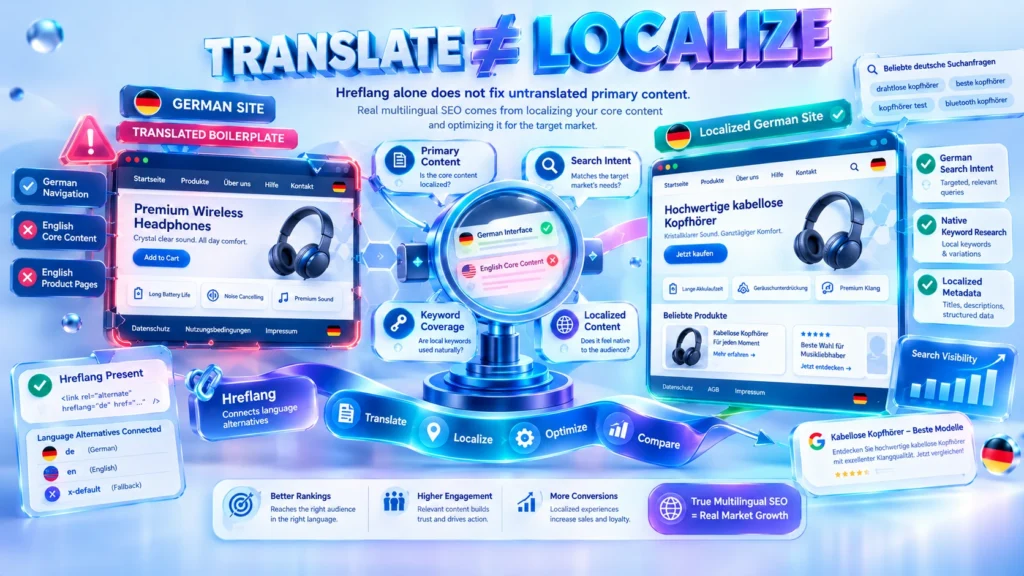
Translating only the boilerplate and shipping untranslated core content.Google’s own documentation warns this can create a poor user experience and result in language versions whose primary content is effectively duplicate.
Auto-redirecting users based on detected location.Forced redirects can make alternate language versions harder for users and Google to consistently access and crawl.
Assuming a translated keyword is the searched keyword.Keyword research needs to happen natively in each target language and market, not by translating a source-language keyword list.
Treating multilingual content as a one-time launch project.Without ongoing governance, language versions drift out of sync and quality gaps between markets widen over time.
Connecting non-equivalent pages through hreflang.Linking pages that merely relate to the same broad topic, rather than genuinely serving the same purpose, misrepresents the relationship instead of clarifying it.
Sending hreflang alternates to redirects, 404s, or noindexed pages.Every hreflang target needs to resolve cleanly and remain indexable, or the annotation points at a broken relationship.
Canonicalizing genuinely different-language pages back to the source language.This treats distinct localized content as if it were a duplicate, which it isn’t.
Publishing machine translation as final editorial output on commercially important pages without review.The production method isn’t the problem;white label SEO quality controlmatters when content is produced at scale.
Letting local teams change URLs without updating hreflang.Among theSEO outsourcing checklist itemsto define upfront is clear ownership of technical changes, because a URL change on one side of an hreflang cluster breaks the relationship for every version still pointing to the old address.
Not every market deserves the same investment at the same time, and enterprise teams need a way to decide which languages get deeper localization first rather than spreading effort evenly and thinly. Useful criteria to weigh together: business revenue potential in that market, existing and projected search demand, current traffic and conversion performance, local operating and sales capability, the cost of localization at the depth that market likely needs, and legal or regulatory complexity.
A market scoring well across demand, revenue potential, and existing traction is usually worth full localization. A market with limited current demand or high legal complexity relative to its opportunity may be well served by human-reviewed translation for now, with a plan to revisit as the market grows, rather than an immediate investment in full localization it may not yet justify.
Translation converts the words from one language to another. Localization goes further, adjusting keyword choices, content structure, and sometimes the content itself to match how people in that specific market actually search and what they actually need, which is what genuinely competitive multilingual SEO requires.
Multilingual SEO addresses serving content in more than one language; multi-regional SEO addresses targeting users in different countries. A site can be one, the other, or both, and the URL structure, hreflang, and content decisions should reflect which problem is actually being solved rather than treating them as one system.
It depends on whether the business needs language separation, country separation, infrastructure independence, or some combination. Country-code domains provide a very clear country-targeting signal but require more infrastructure and separate site management for each one; subdirectories are comparatively simple to maintain within a single host, which is why Growzify often treats them as a practical starting point when separate country domains aren’t required.
No, not as a forced, undismissible redirect. Google’s own documentation warns this can prevent users and search engines from discovering other language versions, and specifically advises against using IP-based analysis to adapt content since it’s unreliable and can interfere with crawling. A visible, switchable language selector with a sensible default is the safer approach.
Not necessarily. Content parity is a reasonable general goal, but genuine market differences, regulatory content, availability, cultural relevance, can justify real divergence. Hreflang should only connect pages that are genuine equivalents of each other; the risk worth watching for is divergence caused by inconsistent publishing rather than a deliberate, legitimate market difference.
Usually no. A genuine translated version is separate localized content serving a different audience, not a duplicate, and should generally be allowed to self-canonicalize. Same-language regional duplicates are the exception worth handling deliberately, where canonical and hreflang may need to work together to serve the right version.
Not always. Use it where a genuine fallback URL exists, particularly for a global or language-selector page meant to catch users whose language or region doesn’t match any of the site’s defined alternates, rather than treating it as a mandatory value on every page set.
No. Google’s own documentation states it determines language from a page’s visible content rather than code-level signals such as the lang attribute or the URL. The lang attribute remains useful for accessibility and browser behavior, but it doesn’t substitute for genuinely translated visible content.
They’re separate layers that both need to work. Hreflang tells search engines which page versions are alternates of each other; it doesn’t make a weak or boilerplate-only translation perform any better. Growzify’s guide ongeotargeting and international Search Console setupcovers the hreflang implementation itself in detail.
Multilingual content quality is one part of the broader technical and content discipline a large international site needs, and Growzify’s enterprise technical SEO checklist covers where this fits alongside the other core areas worth auditing. The canonical and hreflang alignment covered here connects directly to Growzify’s guide on managing redirect chains and canonical tags at enterprise scale, and prioritizing which markets to localize first fits into the broader sequencing covered in Growzify’s guide onbuilding an SEO roadmap for a large website.
If your organization’s language versions were launched under deadline pressure and never fully localized, Growzify’senterprise SEO servicesteam can diagnose which markets need real content investment and build the prioritization around actual search demand.

Chitranshu SharmaA growth strategist, digital marketing consultant, and the founder of Growzify, a performance-driven agency helping brands dominate search, shape perception, and build sustainable online visibility. With 8+ years of hands-on experience in Enterprise SEO, Online Reputation Management (ORM), and AI-led traffic generation, Chitranshu has helped startups, public figures, SaaS companies, and cannabis brands outrank competitors — ethically and at scale.

At Growzify, we are dedicated to helping your business achieve its goals. Are you Ready to take the next step?

Call Now






Growzify digital team is very effective, and easy to work with. Very strong communication and always up for suggestions. Saw 300% growth in web traffic 170% growth in revenue through Facebook ad’s & Amazon. I recommended them to my fellows and they turned their online business into a money making machine.