


White Label SEO vs In-House SEO: Which Path Leads to Growth?
As SEO demand continues to grow, agencies are often faced with a critical decision build an in-house SEO team or partner with a white label provider. Each option impacts scalability, costs, speed, and control in different ways. Choosing the right path depends on how quickly you want to grow, how much flexibility you need, and how efficiently you want to deliver results to clients.

Written byChitranshu Sharma
January 21, 2026
Quick Nav
In today’s digital-first world, the demand for SEO and digital marketing continues to grow rapidly. Many digital marketing agencies require their teams to work beyond capacity to meet client expectations and tight deadlines. Under this pressure, quality often starts to slip, putting client relationships and long-term results at risk.
This decision requires a careful evaluation of financial, operational, and strategic factors, whether to partner with a white-label SEO provider or build an in-house SEO team. A common challenge is determining how to deliver SEO profitably without compromising quality.
White Label SEO vsIn-House: Decide What Scales
Decision Snapshot
- Choose White Label SEO if you manage multiple clients, need fast execution, and want predictable margins without expanding internal teams.
- Choose In-House SEO if your workload is stable and full internal control matters more than speed or scalability.
Every growing business eventually reaches a point where SEO demand outpaces internal capacity. That’s when the decision between building an in-house team or partnering with a white-label SEO provider becomes critical.
White-label SEO services allow agencies to outsource SEO execution to specialized providers while continuing to serve clients under their own brand. This model is often used to extend delivery capacity without changing client-facing operations. On the other hand, the in-house SEO model is typically adopted by businesses that prefer to build and manage their own dedicated teams, giving them direct control over strategy, execution, and internal collaboration.
Industry research from HubSpot indicates that89% of marketers consider SEO a successful strategy. This highlights why many businesses explore more flexible and consistent ways to support SEO deliverables.
Both approaches come with their own advantages and challenges. Choosing the right path requires a clear understanding of your business goals, delivery capacity, and growth plans. When you evaluate both options carefully before designing your strategy. This way, you can choose a model that supports scalability, maintains quality, and delivers consistent SEO results over the long run.
Let’s break downwhite label SEO vs in-house SEO, compare them across real business factors. Helping you decide which model supports sustainable growth for agencies and growing brands. See which model helps SEO projects perform better from a results-driven perspective.
What is SEO?
SEO is a strategic practice that helps digital businesses improve visibility on search engines and reach the right audience at the right time. It ensures that websites align with Google’s algorithm updates and Core Web Vitals, making digital assets both search-engine-friendly and user-focused.
Effective SEO combines multiple best practices, including intent-driven keyword research, high-quality content, strong website structure, clear navigation, technical performance, security, and authority building. Together, these elements create a seamless user experience while helping search engines understand and trust your website. Over time, SEO also positions brands as credible voices and thought leaders within their industry.
When executed efficiently, SEO drives consistent organic traffic, builds long-term trust, and increases brand visibility without relying on ongoing ad spend. It acts as a growth engine that supports long-term business success.
What Is White Label SEO?
White label SEO is a service model that allows businesses and agencies to offer SEO solutions under their own brand. In simple terms, you manage the client relationship, pricing, and communication. A white-label SEO agency partner works behind the scenes to handle strategy, optimization, content, technical fixes, and reporting.
This model is especially popular among digital marketing agencies, SaaS companies, and e-commerce brands. Instead of stretching internal teams thin, businesses use white-label SEO to deliver consistent results, maintain brand control, and scale faster without compromising quality.
How Does White Label SEO Work?
White label SEO is designed to simplify SEO delivery while keeping everything under your brand’s name. It follows a structured, efficient process that helps you deliver SEO services on time and at scale. You focus on client communication and relationships, while the white-label SEO partner manages strategy, execution, and reporting behind the scenes. Here’s how the process works.
- Starts with onboarding and goal alignment.
- You share client objectives, access, and expectations
- White-label SEO agency partner performs SEO audits and builds a strategy
- Monthly execution covers on-page, content, technical, and links
- Reports and updates are fully white-labeled.
- Transparent process: Clients can view in-house work for a brand name.
- You focus on sales, relationships, and growth.
To your clients, it feels completely in-house. For your business, it creates space to focus on growth, relationships, and scaling. SEO runs smoothly in the background.
Advantages of White Label SEO for Businesses
White label SEO isn’t just about outsourcing work; it’s about unlocking faster and smarter growth. It gives businesses the flexibility to scale without adding internal pressure.
- Scale SEO services quickly without hiring or training
- Get access to specialized SEO expertise across multiple areas
- Receive predictable monthly deliverables and reporting
- Reduce operational and delivery risks
- Improve margins with cost-effective pricing
- Maintain brand control while outsourcing execution
With the right partner, you gain expertise, consistency, and cost efficiency all at once. This makes white label SEO a reliable model for long-term business growth.
Cons of White Label SEO
Like any model, white-label SEO has its challenges. You rely heavily on your partner’s processes, communication, and consistency. If expectations aren’t clearly defined, delays or mismatched strategies can affect client satisfaction.
So you need to be careful while you onboard thewhite label SEO provider for your business. You need to specify the backgrounds and experience.
There’s also less direct control over day-to-day execution compared to an in-house team. That’s why choosing the right white-label SEO agency partner and starting with a trial is critical. With proper evaluation, clear workflows, and transparency, most of these risks can be minimized effectively.
What Is In-House SEO?
In-house SEO refers to building and managing a dedicated internal team that handles all SEO activities for your business or agency. This typically includes hiring SEO specialists, content writers, technical SEO experts, and managers who work exclusively on your brand. With an in-house setup, your business relies heavily on this team for execution, strategy, and ongoing optimization.
The in-house SEO team manages everything from keyword research and content creation to technical SEO improvements and link-building strategies. Because the team works closely within your organization, strategies align more closely with business goals and brand vision.
How In-House SEO Works
In-house SEO works best when your business is ready to take full ownership of its SEO strategy and execution. It’s a long-term approach built for stability, control, and consistent internal collaboration.
- You have steady, long-term SEO needs.
- You can invest in hiring, training, and tools
- You prefer full internal control over execution
When you have steady SEO requirements, the budget to invest in people and tools, and the need for complete control, an in-house SEO team can deliver focused and brand-aligned results over time.
Common Challenges of In-House SEO
While in-house SEO offers control and alignment, it also comes with practical challenges that many businesses overlook. As workloads grow and search algorithms evolve, managing everything internally can become demanding.
- High hiring and retention costs
- Slow scaling during peak demand
- Dependency on a small team
- Skill gaps across technical, content, and link-building SEO
These challenges don’t make in-house SEO ineffective, but they do require time, budget, and constant management. For growing businesses, these limitations often lead teams to explore more flexible SEO models.
In-house SEO requires consistent investment in hiring, training, tools, and team management over time. While it offers stability, it often lacks the flexibility to scale quickly or adapt to sudden changes in workload or business growth.
White Label SEO vs In-House SEO: Growth Comparison
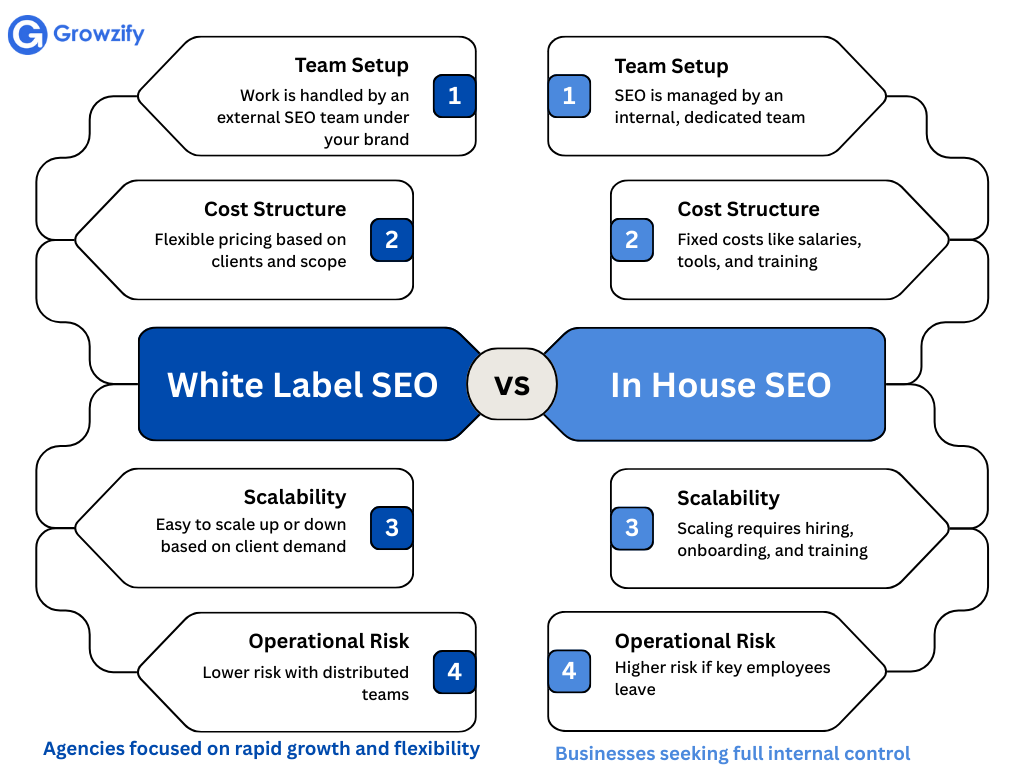
When it comes to growth, SEO, and client retention. This is where the real difference between white-label SEO and in-house SEO shows up in execution. Both models can deliver results, but they scale very differently. Below is a direct comparison of white label SEO and in-house SEO across key growth factors.
1. Speed to Scale
In-House SEO: Scaling with an in-house SEO team is typically slow. Businesses must hire, onboard, and train talent before taking on additional work. Growth is closely tied to team availability and retention, which limits scalability during peak demand.
White Label SEO:White-label SEO enables rapid scaling. You can onboard new clients immediately while your partner manages execution, reporting, and results. Your focus stays on client communication and growth.
Winner: White Label SEO— Faster execution, scalable delivery, and reduced operational delays.
2. Cost & ROI
In-House SEO: In-house SEO involves fixed and recurring costs such as salaries, SEO tools, training, and employee turnover. These expenses remain constant regardless of workload, which delays ROI and increases financial risk during slower periods.
White Label SEO:White label SEO follows a flexible, client-based pricing model. You pay only for the scope and services required for each client, while the remaining margin becomes your profit. There are no hiring, training, or retention costs.
Winner for Sustainable ROI:White Label SEO:With lower overhead and predictable expenses, white label SEO delivers better margins, easier client retention, and faster profitability compared to in-house teams.
3. Expertise & Coverage
In-House SEO:In-house SEO expertise is limited to the skills of the internal team. Keeping up with algorithm updates and advanced SEO practices requires continuous training, which adds time, cost, and operational overhead.
White Label SEO:A white-label SEO Agency gives your business instant access to a broad range of specialist teams. including technical SEO experts, content strategists, local SEO professionals, ecommerce SEO specialists, and link-building teams.
Winner:White Label SEO asit delivers deeper expertise and wider coverage without the burden of constant training. While in-house SEO, you need to train the team, and for this, the expenses can increase
4. Risk & Dependency
In-House SEO:In-house SEO carries a higher dependency on key team members. If an employee leaves or underperforms, project timelines and SEO results can be directly impacted.
White Label SEO:White label SEO operates with distributed teams, reducing single-point failure and ensuring consistent delivery even during team changes.
Winner:White Label SEO.Lower dependency means reduced risk and more reliable SEO execution.
5. Control & Brand Ownership
In-House SEO:With in-house SEO, you have complete internal control over strategy, communication, and execution.
White Label SEO:White-label SEO maintains full brand ownership while execution is handled externally under your branding.
Winner:Tie (with the right partner)
With a trusted white-label SEO Agency partner, you maintain brand control while benefiting from expert execution.
Business growth depends on how efficiently SEO results are delivered and how well clients are retained. The right model depends on your speed, resources, and long-term goals. Choose the approach that allows you to scale smoothly, deliver consistent results, and maintain client confidence without unnecessary complexity.
White Label SEO in India Leads to Faster Growth
White-label SEO in India has emerged as a preferred growth solution for agencies worldwide. It combines deep expertise, scalable execution, and cost efficiency, making it easier for businesses to grow without operational strain. India has become a global hub for white-label SEO services due to:
- Highly skilled SEO professionals
- Strong technical and content expertise
- Cost-effective pricing models
- Experience handling international markets
For agencies serving global markets,white label SEO partnersdeliver the right mix of quality, affordability, and scalability. This balance makes faster, sustainable growth achievable without compromising results.
When In-House SEO Is the Right Path
In-house SEO can be the right choice when your business has stable needs and prefers complete control over its SEO efforts. It works best when long-term investment and internal alignment matter, and management rapid scaling.
- Serve only your own brand.
- SEO workload is predictable.
- For those who can afford long-term staffing costs.
- Growth speed is not urgent.
For businesses with workloads and the resources to support a dedicated team. In-house SEO offers consistency and deeper brand understanding and works best to deliver favorable results for the clients. However, it requires patience, ongoing investment, and careful management to deliver sustained results.
When White Label SEO Is the Smarter Growth Path
White label SEO becomes the smarter growth path when your business needs to scale quickly without stretching internal resources.
You manage multiple clients.
- Demand fluctuates month to month. You can handle those
- You want to scale without hiring.
- You need fast execution and consistent delivery.
It offers flexibility, speed, and expert execution without the delays that come with building an in-house team.
Final Verdict: Which Path Leads to Growth?
If your goal is controlled, long-term internal SEO, in-house may work. But if your goal is faster scaling, higher margins, and reduced risk, white-label SEO is the clearer growth path. Businesses today aim to protect profit margins while controlling operational costs.
The SEO industrygenerates billions every yearand continues to be one of the most successful and fast-growing digital marketing channels. Yet many businesses still struggle with resource allocation, skill gaps, workflow bottlenecks, and scaling on time. That’s why understanding the core differences between white-label SEO and in-house SEO matters. However, these comparisons can help you to find which model works best.
For most agencies and growing businesses, white-label SEO leads to expansion without complexity. You can focus on sales, relationships, and brand building while experts handle execution. Growth is ultimately determined by how efficiently SEO results are delivered. Choose the model that allows you to scale confidently, protect your brand, and grow without operational bottlenecks.

Chitranshu SharmaA growth strategist, digital marketing consultant, and the founder of Growzify, a performance-driven agency helping brands dominate search, shape perception, and build sustainable online visibility. With 8+ years of hands-on experience in Enterprise SEO, Online Reputation Management (ORM), and AI-led traffic generation, Chitranshu has helped startups, public figures, SaaS companies, and cannabis brands outrank competitors — ethically and at scale.
Explore More Articles
How to Find and Compare Local SEO Outsourcing Providers
How to Find and Compare Local SEO Outsourcing Providers Finding a local SEO outsourcing provider...
October 13, 2026Outsourcing

Inside a White Label SEO Campaign: How the Work Gets Done
Inside a White Label SEO Campaign: How the Work Gets Done Clients see a single...
October 13, 2026White Label

How to Vet an SEO Outsourcing Provider Before You Sign a Contract
How to Vet an SEO Outsourcing Provider Before You Sign a Contract A polished proposal...
October 9, 2026Outsourcing

Multilingual SEO Best Practices: Optimize Your Multi-Language Website
Multilingual SEO Best Practices: Optimize Your Multi-Language Website Translating a page and localizing it for...
October 7, 2026SEO
What Makes In-House Enterprise SEO Work Different Day-to-Day?
What Makes In-House Enterprise SEO Work Different Day-to-Day? On a small site, deciding to fix...
October 7, 2026Enterprise

How Core Algorithm Updates Impact Large Sites Differently Than Small Ones
How Core Algorithm Updates Impact Large Sites Differently Than Small Ones A large enterprise site...
October 7, 2026Enterprise
When Should You Outsource SEO? 11 Signs It Makes Sense
When Should You Outsource SEO? 11 Signs It Makes Sense Outsourcing SEO does not necessarily...
September 26, 2026Outsourcing